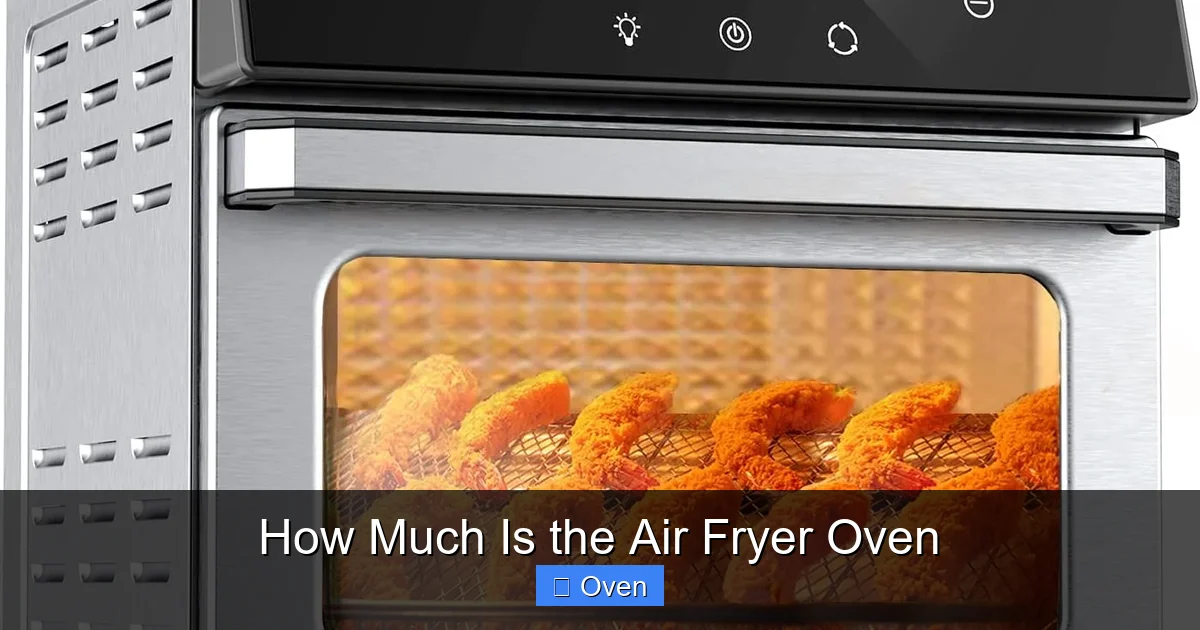
Air fryer oven prices range from $50 for basic models to $500+ for premium units, with most quality options landing between $100-$250. Your final cost depends heavily on size, features like rotisserie or smart tech, and brand reputation. Prioritize capacity and essential functions over flashy extras to get the best value for your kitchen needs.
Key Takeaways
- Price Range is Wide: Entry-level air fryer ovens start around $50-$80, while high-end models with advanced features can exceed $500. Most reliable, feature-rich options fall between $100-$250.
- Size Drives Cost Significantly: Larger capacity (10+ quarts) models cost substantially more than compact 5-6 quart units. Match the size to your household needs to avoid overspending.
- Features Impact Value: Rotisserie, dehydrate modes, smart connectivity, and premium build materials increase price. Focus on features you’ll actually use regularly.
- Brand Matters for Quality & Warranty: Established brands (Ninja, Cosori, Instant Pot) often cost more but offer better durability, customer support, and longer warranties than unknown brands.
- Sales & Bundles Offer Savings: Major holidays (Black Friday, Prime Day) and retailer-specific sales can slash prices by 20-40%. Bundles with accessories sometimes provide better value.
- Consider Total Cost of Ownership: Factor in potential accessory costs (trays, racks) and energy efficiency. A slightly pricier, efficient model may save money long-term.
Quick Answers to Common Questions
What’s the absolute cheapest air fryer oven I can buy?
You can find basic 5-quart models from brands like Dash or store brands for around $50-$60, especially during sales. However, these often have limited features, smaller capacity, and may lack durability. Consider if the ultra-low price fits your actual needs.
Is a $100 air fryer oven good enough for a family of four?
Yes, absolutely! Many excellent 7-8 quart models from brands like Cosori, Ninja, or Instant Pot fall in the $100-$150 range. They offer sufficient capacity for family meals, essential functions (air fry, bake, roast, broil), and reliable performance. This is often the best value sweet spot.
Do I really need a smart air fryer oven with Wi-Fi?
Probably not, unless you have a specific need. Smart features add $50-$150+ to the price. They’re useful for remote start/monitoring if you have irregular schedules, but many users find them unnecessary. Prioritize core cooking performance and capacity first.
How much should I budget for extra accessories?
Factor in $15-$30 for essential extras like an additional crisper basket or baking pan, especially if the bundle doesn’t include them. Avoid buying unnecessary gadgets; stick to items that expand the oven’s core functionality for your needs.
Are refurbished air fryer ovens a good deal?
Yes, often excellent! Certified refurbished units from the manufacturer or major retailers (like Best Buy) are thoroughly tested, repaired if needed, come with a warranty (often 90 days to 1 year), and cost 20-30% less than new. A great way to get a higher-end model affordably.
📑 Table of Contents
- How Much Is the Air Fryer Oven? Your Complete Price Guide
- What Determines the Price of Your Air Fryer Oven?
- Realistic Air Fryer Oven Price Ranges: What to Expect
- Getting the Best Value: How Much Should YOU Spend?
- Where to Buy Your Air Fryer Oven (And What to Watch For)
- Beyond the Price Tag: Making Your Air Fryer Oven Work for You
- Conclusion: Finding Your Perfect Air Fryer Oven Price Point
How Much Is the Air Fryer Oven? Your Complete Price Guide
Hey there! So, you’re thinking about joining the air fryer oven revolution? Smart move. These countertop wonders have exploded in popularity, promising crispy fries, juicy chicken, and even baked goods with way less oil and hassle than a traditional oven. But as you start browsing online or walking down the kitchen appliance aisle, one question inevitably pops up: “How much is the air fryer oven, really?”
It’s a great question, but the answer isn’t as simple as you might hope. Unlike, say, a basic toaster, air fryer ovens come in a dizzying array of sizes, features, and brands, each with its own price tag. You could easily find yourself staring at a $60 model one moment and a $450 beast the next, wondering what on earth justifies that massive price difference. Is the expensive one *that* much better? Is the cheap one a total dud? Don’t worry – we’re going to cut through the confusion. This guide will break down exactly what drives the cost of an air fryer oven, give you realistic price ranges for different needs, and help you figure out how much you should *actually* spend to get the best value for your kitchen. Think of it as your friendly, no-nonsense roadmap to navigating the air fryer oven price jungle.
The truth is, the price of an air fryer oven is influenced by a whole bunch of factors working together. It’s not just about the brand name slapped on the front (though that plays a role!). The physical size of the unit, the number and type of cooking functions it offers, the quality of the materials used in its construction, and even the specific retailer you buy from can cause the price to swing dramatically. Understanding these elements is key to making an informed decision. You don’t want to overspend on features you’ll never use, but you also don’t want to get stuck with a tiny, flimsy model that can’t handle your family’s dinner needs. Let’s dive deep into what makes these prices tick.
What Determines the Price of Your Air Fryer Oven?

Visual guide about How Much Is the Air Fryer Oven
Image source: experteasy.com.au
Before we start throwing out dollar figures, it’s crucial to understand *why* prices vary so much. Knowing the drivers behind the cost helps you evaluate whether a specific model is worth its price tag for *your* situation. It’s like understanding why a sports car costs more than a compact sedan – it’s not arbitrary; specific features and capabilities justify the difference.
1. Capacity: The Biggest Price Factor
Let’s be real: size matters, especially when it comes to feeding people. The internal capacity of an air fryer oven, usually measured in quarts, is arguably the single biggest factor impacting its price. Why? Larger capacity requires more robust heating elements, a bigger footprint (meaning more materials), and often more complex airflow engineering to ensure even cooking throughout the larger space.
* **Compact (5-6 Quarts):** These are the budget-friendly workhorses, perfect for singles, couples, or small families cooking side dishes. Think crispy chicken wings for two, a small batch of roasted veggies, or reheating leftovers. You’ll typically find these starting around **$50-$100**. Brands like Dash or basic models from Ninja often fit here. They’re great for minimal counter space but struggle with larger items like a whole chicken or a 9×13 baking dish.
* **Standard/Mid-Size (7-10 Quarts):** This is the sweet spot for most households (families of 3-4). You can comfortably cook a whole chicken (yes, really!), a large batch of fries, a 9×13 casserole, or multiple pizzas at once. This is where you’ll find the majority of popular models from brands like Cosori, Ninja Foodi (some models), and Instant Pot. Expect prices in the **$100-$200** range for solid, feature-complete units. This range offers the best balance of capacity, features, and value for many buyers.
* **Large (11+ Quarts):** Need to feed a crowd or love batch cooking? Large-capacity ovens (12-16+ quarts) are the heavy lifters. They can handle multiple whole chickens, large roasts, full sheet pans of food, or even small turkeys. These require significant counter space and power. Prices start around **$180-$250** and can easily climb to **$350-$500+** for premium brands (like high-end Ninja or specialty brands) with advanced features. If you regularly cook for 5+ people, this might be necessary, but it’s overkill for smaller households.
2. Features & Functions: Beyond Basic Air Frying
All air fryer ovens do the core job: circulate hot air for crispy results. But the *extra* functions they offer significantly bump up the price. Think of these as the “bells and whistles” – some are genuinely useful, others are more gimmicky.
* **Essential Multi-Functions:** Most mid-to-high-range models include several preset modes beyond air fry: bake, roast, broil, toast, reheat, and keep warm. These are generally worth having and don’t drastically increase cost on standard models. A model with just “air fry” and “bake” might be cheaper than one with 10+ presets.
* **Premium/Specialty Functions:** This is where prices jump. Features like:
* **Rotisserie:** A motorized spit for rotating chicken or roasts. Adds complexity and cost ($20-$50+ premium).
* **Dehydrate:** For making jerky, fruit leathers, or dried herbs. Requires lower, consistent temps ($15-$40 premium).
* **Proof/Yogurt:** For baking enthusiasts ($10-$30 premium).
* **Smart Connectivity (Wi-Fi/App Control):** Allows remote start, monitoring, and recipe access via your phone. A major price driver, often adding $50-$150+ (e.g., Cosori Pro II, Ninja Foodi Smart XL). Ask yourself: Will you *actually* use your phone to start dinner while stuck in traffic?
* **Advanced Controls:** Digital touchscreens, precise temperature probes (for meat), or sous vide capabilities add cost.
* **Build Quality & Materials:** Cheaper models often use thinner plastic that can warp or feel flimsy. Higher-priced units typically feature heavier-duty stainless steel interiors, better insulation (for efficiency and safety), and more durable exteriors. This impacts longevity and cooking performance. A $150 model with a stainless steel interior will likely outlast and cook better than a $70 all-plastic model.
3. Brand Reputation & Support
You often pay a premium for trusted brands, and for good reason. Established brands like Ninja, Cosori, Instant Pot, Breville, and Cuisinart invest heavily in:
* **R&D:** Better airflow engineering, more reliable heating elements.
* **Quality Control:** Fewer defects and consistent performance.
* **Customer Service:** Accessible support teams and clearer warranty processes.
* **Warranty Length:** Premium brands often offer 1-2 year warranties, while ultra-budget brands might have only 90 days or none at all. A longer warranty is a hidden value, potentially saving you replacement costs.
Unknown brands on Amazon or at discount stores might offer tempting low prices ($50-$80), but they often cut corners on materials, safety certifications, and support. You might save upfront but risk a shorter lifespan, inconsistent cooking, or no recourse if it breaks. Think of it as an investment in reliability.
4. Retailer & Timing: When and Where You Buy
The sticker price isn’t always the final price! Savvy shopping can unlock significant savings:
* **Sales & Promotions:** Black Friday, Cyber Monday, Amazon Prime Day, and major holiday weekends (Memorial Day, Labor Day) are prime times for deep discounts (20-40% off). Sign up for retailer newsletters (Best Buy, Target, Walmart, Amazon) for early access.
* **Retailer Exclusives:** Sometimes brands offer slightly different models or bundles exclusively at certain stores (e.g., a Costco bundle with extra trays).
* **Open-Box/Refurbished:** Reputable retailers (like Best Buy) often sell certified refurbished units at 20-30% off, with warranties. A great way to get a higher-end model for less.
* **Bundle Deals:** Buying with essential accessories (extra racks, baking pans) can offer better value than purchasing separately later.
Realistic Air Fryer Oven Price Ranges: What to Expect

Visual guide about How Much Is the Air Fryer Oven
Image source: supergoldenbakes.com
Now that we know the drivers, let’s translate that into concrete price brackets. Remember, these are *typical* ranges for new, standard models from reputable brands (not including major sales or ultra-budget/no-name brands). Prices fluctuate, so treat these as guides.
Budget Tier: $50 – $100
* **What You Get:** Compact size (5-6 quarts), basic air fry and bake functions (maybe toast/reheat), simple dial controls, primarily plastic construction. Think Dash Compact, basic Ninja models (like the AF101), or store-brand options.
* **Best For:** Singles, couples, very small households, or as a secondary appliance for specific tasks (reheating, small batches). Great if counter space is extremely limited and your needs are simple.
* **The Catch:** Limited capacity means you can’t cook larger items easily. Build quality might be less durable. Fewer features and shorter warranties (often 1 year or less). Performance can be inconsistent, especially at higher temps or for longer cooks. *Example: Cooking a single portion of frozen fries works great, but trying to roast a whole chicken? Forget it.*
* **Value Verdict:** Good *if* your needs perfectly match the limitations. Often a false economy if you outgrow it quickly. Prioritize models with at least a 1-year warranty.
Mid-Range Tier: $100 – $200
* **What You Get:** The Goldilocks zone! Standard size (7-10 quarts), multiple essential functions (air fry, bake, roast, broil, toast, reheat, keep warm), digital controls with presets, better build quality (often stainless steel interior), and more consistent performance. Brands like Cosori (Premium, Pro), Ninja (Foodi 6-in-1, some AF models), Instant Pot (Vortex Plus), and Gourmia dominate here.
* **Best For:** The vast majority of households (families of 3-4). Handles whole chickens, large batches of sides, casseroles, and most baking tasks comfortably. Offers the best balance of capacity, features, reliability, and price.
* **The Sweet Spot:** This is where you’ll find the highest value. You get sufficient capacity for everyday family meals, reliable performance, essential multi-functionality, and decent build quality without breaking the bank. *Example: Roasting a 4-5 lb chicken with veggies underneath, baking a 9×13 lasagna, or air frying a large batch of crispy Brussels sprouts for dinner.*
* **Value Verdict:** The recommended starting point for most buyers. Offers the best combination of features, capacity, and durability for the price. Look for sales to get into this range for under $150.
Premium Tier: $200 – $350+
* **What You Get:** Large capacity (11-16+ quarts), extensive function lists (rotisserie, dehydrate, proof, yogurt, sous vide), smart connectivity (Wi-Fi/app control), premium materials (heavy-duty stainless steel, better insulation), advanced controls (precision probes, sous vide), and often longer warranties (1-2 years). Think Ninja Foodi Smart XL, Breville Smart Oven Air Fryer Pro, high-end Cosori models, or specialty brands like Cuisinart.
* **Best For:** Large families (5+), serious home cooks, meal preppers, or those who want the absolute latest tech and maximum versatility. Ideal if you frequently cook large roasts, multiple dishes simultaneously, or crave app-controlled convenience.
* **The Premium Perks:** Superior cooking performance (more even heat, better airflow), greater durability, unique capabilities (like perfect rotisserie chicken), and the convenience of smart features. *Example: Cooking a full Thanksgiving turkey (if capacity allows), dehydrating a large batch of apple chips, or starting a roast from your phone while still at the grocery store.*
* **Value Verdict:** Justified *only* if you genuinely need the large capacity or will use the advanced features regularly. For many, the mid-range tier is sufficient. The smart features add significant cost; ensure they solve a real problem for you. Premium build quality does translate to longer lifespan.
Ultra-Premium/Luxury Tier: $350 – $500+
* **What You Get:** Top-tier brands (Breville, high-end Cuisinart), maximum capacity (16+ quarts), professional-grade construction, every possible function imaginable, exceptional build quality, and often superior aesthetics. These are the “Ferraris” of air fryer ovens.
* **Best For:** Serious culinary enthusiasts, very large households, or those who prioritize appliance aesthetics and ultimate performance above all else. Less common for typical home use.
* **Value Verdict:** Hard to justify for most home cooks. The marginal gains over a good $250-$300 model are often minimal for everyday tasks. Primarily for enthusiasts who want the absolute best.
Getting the Best Value: How Much Should YOU Spend?
Visual guide about How Much Is the Air Fryer Oven
Image source: airfryingfoodie.com
Okay, so you know the ranges. But how do you decide where *you* fit in? Spending $50 might be perfect for one person, while $300 is essential for another. It’s all about matching the appliance to *your* life. Here’s how to figure out your sweet spot.
Assess Your Household Size & Cooking Habits
This is step one. Be brutally honest:
* **How many people do you regularly cook for?** A single person or couple can easily get by with a 5-6 quart model ($50-$100). A family of 4 needs at least 7-8 quarts ($100-$180). Families of 5+ should seriously consider 10+ quarts ($150-$250+).
* **What do you cook most often?** Are you mainly reheating leftovers and making frozen fries? A basic model suffices. Do you roast whole chickens, bake casseroles, or make large batches of snacks? You need mid-range capacity and functions. Love making jerky or yogurt? Factor in dehydrate/proof functions (adds $20-$50).
* **How much counter space do you have?** Measure! A large 12-quart oven needs significant real estate. Don’t buy a beast if it will be crammed in a corner.
Prioritize Features You’ll Actually Use
This is where many people overspend. That shiny rotisserie function? If you’ve never cooked a rotisserie chicken in your life, skip it. The Wi-Fi app? If you’re not tech-savvy or rarely start dinner remotely, it’s wasted money. Make a list:
1. **Must-Haves:** (e.g., 8+ quarts, air fry, bake, roast, broil)
2. **Nice-to-Haves:** (e.g., dehydrate, extra rack)
3. **Gimmicks to Avoid:** (e.g., built-in scales, overly complex presets you won’t use)
Focus your budget on the Must-Haves. A $150 model with perfect Must-Haves is better value than a $250 model loaded with features you ignore.
Consider Long-Term Value, Not Just Sticker Price
Think beyond the initial purchase:
* **Durability:** A $120 model with a stainless steel interior and 2-year warranty is often a better long-term investment than a $70 all-plastic model with a 90-day warranty that might break in a year.
* **Energy Efficiency:** Larger, better-insulated models (often mid-to-high range) may use slightly more power per cycle but cook faster and more evenly, potentially saving energy overall compared to a smaller, inefficient model running longer. Check energy guides if available.
* **Accessory Costs:** Factor in the cost of essential extras like additional racks or baking pans. Sometimes a bundle deal is smarter.
* **Resale Value:** Reputable brands hold value better if you ever upgrade.
Smart Shopping Strategies to Save
You don’t have to pay full price! Here’s how to stretch your budget:
* **Wait for Sales:** Patience pays off. Major holidays are the best times. Sign up for price drop alerts on sites like CamelCamelCamel (Amazon) or Keepa.
* **Consider Refurbished:** Certified refurbished units from the manufacturer or major retailers (Best Buy, Target) are rigorously tested, come with warranties, and cost 20-30% less. A fantastic way to get a premium model affordably.
* **Check Retailer Exclusives:** Sometimes Costco, Sam’s Club, or Target have slightly different bundles or models at better prices.
* **Bundle Wisely:** If you need extra racks or pans, see if a bundle offers savings versus buying separately. Don’t pay for accessories you don’t need.
* **Read Reviews Critically:** Look beyond the star rating. Search reviews for “durability,” “long term,” “warranty.” See if common issues align with your priorities.
Where to Buy Your Air Fryer Oven (And What to Watch For)
You’ve got your price range and features list. Now, where do you actually pull the trigger? The right retailer can impact price, return policy, and overall experience.
Major Online Retailers: Amazon, Walmart.com, Target.com
* **Pros:** Huge selection, easy price comparison, frequent sales (especially Amazon Prime Day, Black Friday), user reviews, fast shipping (often free with Prime or thresholds), easy returns (usually).
* **Cons:** Risk of counterfeit or third-party sellers (stick to “Ships from/Sold by Amazon.com” or major retailers directly), overwhelming choice can lead to decision fatigue.
* **Best For:** Finding the best price, reading extensive reviews, convenience. *Tip: Filter for “Amazon’s Choice” or highly rated (4+ stars) models from reputable sellers.*
Big-Box Stores: Best Buy, Target, Walmart (In-Store & Online)
* **Pros:** See and touch models in-store (great for checking size/build quality), immediate pickup, often price match online, strong return policies, frequent in-store sales/clearance.
* **Cons:** Selection might be smaller than online, in-store stock can be limited.
* **Best For:** People who want to physically assess the appliance before buying, those needing it immediately, or wanting the security of a known return policy. *Tip: Check online inventory for your local store before visiting.*
Manufacturer Websites (Ninja, Cosori, Instant Pot, etc.)
* **Pros:** Direct access to the latest models, potential for exclusive bundles or colors, often the best warranty support, direct customer service.
* **Cons:** Usually the highest sticker price (though they run frequent sales), limited selection (only their brands).
* **Best For:** Loyalty to a specific brand, seeking exclusive bundles, or when manufacturer sales are strong (sign up for their newsletters!). *Tip: Check their “Outlet” or “Refurbished” sections for deals.*
Warehouse Clubs: Costco, Sam’s Club
* **Pros:** Often excellent value on mid-to-high range models, especially during sales. Frequently include bundles with extra accessories (racks, pans) at a better price than buying separately. Strong return policies.
* **Cons:** Requires membership, selection is limited to what they carry each season, less frequent new model releases.
* **Best For:** Members looking for a good deal on a reliable mid-range model with useful extras. *Tip: Check their online site even if you don’t have a local club – shipping is often free for members.*
What to Watch Out For
* **Too-Good-to-Be-True Prices:** Extremely low prices ($40 for a 10-quart model) on unknown brands are red flags for poor quality or counterfeits.
* **Third-Party Seller Risks:** On Amazon/Walmart.com, verify the seller. Avoid sellers with low ratings or no clear return policy.
* **Return Policies:** Understand the return window (30 days is standard, some are 60-90) and restocking fees (rare, but possible). Ensure it’s hassle-free if the size/features aren’t right.
* **Warranty Registration:** Some brands require registration within a short timeframe (e.g., 30 days) to activate the full warranty. Do this immediately after purchase.
Beyond the Price Tag: Making Your Air Fryer Oven Work for You
You’ve bought it! Now, how do you ensure you get the most value from your investment, regardless of how much you spent? It’s not just about the purchase price; it’s about maximizing its utility and lifespan.
Master the Basics for Best Results
Even the most expensive oven won’t perform well if you don’t use it right. These tips apply to *any* model:
* **Don’t Overcrowd:** This is the #1 mistake! Air needs to circulate. Leave space between items for crispy results. Cook in batches if needed.
* **Preheat Properly:** Just like a regular oven, preheating (3-5 mins) ensures even cooking and better texture from the start.
* **Use the Right Accessories:** The included racks and trays are designed for optimal airflow. Avoid covering the entire tray with foil; use parchment with holes if needed.
* **Shake/Flip Halfway:** For even cooking on items like fries or veggies, shake the basket or flip items midway through the cook time.
* **Check Early, Check Often:** Ovens vary. Start checking food a few minutes before the recipe suggests. Use a meat thermometer for proteins.
Maintenance is Key to Longevity
Taking care of your oven prevents costly replacements and keeps it performing well:
* **Clean After *Every* Use:** Wipe down the interior and exterior with a damp cloth. Clean the crisper basket/tray thoroughly (most are dishwasher safe). Grease buildup is a fire hazard and affects performance.
* **Deep Clean Monthly:** Remove racks and trays. Wipe the interior walls and heating element area (unplugged and cooled!) with a non-abrasive cleaner. Avoid getting water inside the electrical components.
* **Check the Door Seal:** Ensure it’s clean and intact for proper heat retention. Replace if damaged (check manufacturer for parts).
* **Store Accessories Properly:** Keep racks and trays organized to avoid warping or scratching.
Maximize Versatility: More Than Just Fries
Get your money’s worth by using all its functions:
* **Reheat Leftovers:** Crisp up pizza, fried chicken, or roasted veggies better than a microwave.
* **Toast & Warm:** Perfect for bagels, English muffins, or warming plates.
* **Bake Small Batches:** Cookies, muffins, small cakes – great for when you don’t want to heat the big oven.
* **Roast Vegetables:** Toss with a little oil and seasoning for caramelized, tender-crisp results.
* **Broil:** Get a nice sear on steaks, fish, or melt cheese on casseroles.
* **Dehydrate (If Available):** Make healthy snacks like apple chips, banana slices, or beef jerky.
* **Proof Dough (If Available):** Create the perfect warm environment for rising bread or pizza dough.
Conclusion: Finding Your Perfect Air Fryer Oven Price Point
So, how much is the air fryer oven? As we’ve discovered, the answer is beautifully nuanced. It’s not a single number, but a spectrum shaped by your unique kitchen needs, cooking habits, and budget. The magic lies in understanding that spectrum and finding *your* perfect intersection of capacity, features, quality, and price.
Remember, the cheapest model ($50-$80) might be perfect for a solo diner reheating meals, but it will leave a family of four frustrated and hungry. Conversely, splurging $400+ on a smart, rotisserie-equipped giant is overkill if you only ever make frozen fries. The true value isn’t found at the absolute lowest or highest price point, but in the model that reliably, efficiently, and enjoyably handles *your* most common cooking tasks without breaking the bank or cluttering your counter.
Focus on the essentials: match the capacity to your household size, prioritize the functions you’ll actually use week after week, and invest in decent build quality from a reputable brand for longevity. Don’t be seduced by features that sound cool but solve problems you don’t have. Leverage sales, consider refurbished options, and always read reviews with a critical eye towards durability and real-world performance.
An air fryer oven is more than just an appliance; it’s a tool to make your cooking easier, healthier, and more enjoyable. By spending wisely based on your actual needs – whether that’s $75 for a compact workhorse or $225 for a versatile family hub – you’re not just buying a kitchen gadget. You’re investing in countless crispy, delicious meals, saved time, and the simple joy of a perfectly cooked dish, all without the hassle of a full oven. So, take a deep breath, assess your needs, do your homework, and get ready to enjoy the incredible value and convenience your new air fryer oven brings to your kitchen. Happy (and affordable) air frying!
Frequently Asked Questions
Why are some air fryer ovens so much more expensive than others?
Price differences stem from capacity (larger = more expensive), features (rotisserie, smart tech, dehydrate add cost), build quality (stainless steel vs. plastic), brand reputation (better support/warranty), and retailer markup. A $250 model typically offers significantly more capacity, durability, and functions than a $60 model.
What size air fryer oven do I need for a family of 4?
For a family of 4, a 7-10 quart capacity is ideal. This size comfortably handles a whole chicken (4-5 lbs), a 9×13 casserole, large batches of sides, or multiple pizzas. Avoid going smaller than 6 quarts, as it will be too cramped for family meals.
Can I bake a cake in an air fryer oven?
Yes! Most mid-range and larger air fryer ovens have a “bake” function perfect for small to medium cakes, cupcakes, brownies, and quick breads. Use the included baking pan or a standard oven-safe pan that fits. Adjust baking time slightly (often 5-10 minutes less) and check early.
How long do air fryer ovens typically last?
With proper care (regular cleaning, not overloading), a quality air fryer oven from a reputable brand (Ninja, Cosori, Instant Pot) typically lasts 3-7 years. Cheaper models may last 1-3 years. Build quality and usage frequency are the biggest factors. A good warranty (1-2 years) provides peace of mind.
Is an air fryer oven cheaper to run than a regular oven?
Generally, yes, especially for small to medium tasks. Air fryer ovens heat up faster, cook faster due to concentrated airflow, and have a smaller cavity to heat. This translates to lower energy consumption per meal compared to preheating and running a large conventional oven for the same task.
What’s the difference between an air fryer and an air fryer oven?
Traditional air fryers are basket-style, compact, and great for small batches (fries, wings). Air fryer ovens are larger countertop units with a door, multiple racks, and more functions (bake, roast, toast, broil). Ovens offer greater capacity, versatility, and are better for whole chickens, casseroles, or baking, but take up more counter space.