There’s no single “normal” caffeine amount—it varies wildly based on bean type, roast, and brewing method. A standard 8oz cup of drip coffee typically contains 80-100mg, but espresso packs 63mg in just 1oz. Understanding these factors helps you enjoy coffee smarter and avoid jitters.
Key Takeaways
- Cup size defines “normal”: A standard cup is 8oz (240ml), not the 12oz mugs many use daily.
- Bean variety matters most: Robusta beans have 2x more caffeine than Arabica—common in espresso blends.
- Roast level is a myth: Dark roasts have slightly less caffeine by weight than light roasts due to density.
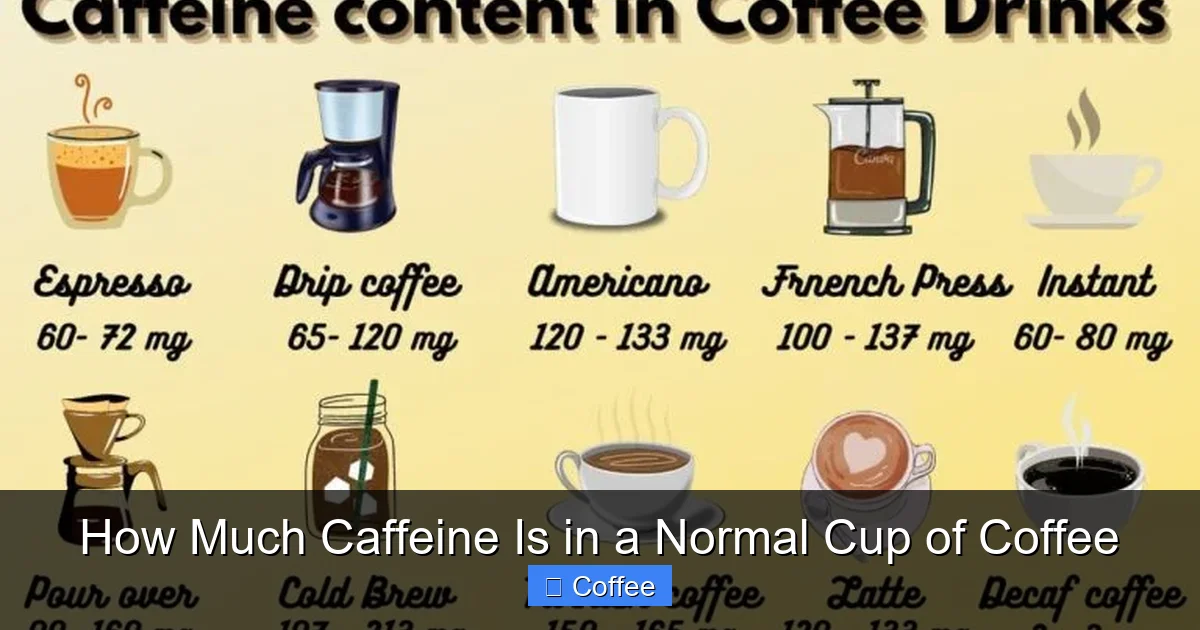
- Brewing method changes everything: Drip coffee averages 80-100mg per 8oz, while French press can hit 100-150mg.
- Espresso isn’t “stronger”: A 1oz shot has ~63mg caffeine—less than drip coffee per ounce but more concentrated.
- Daily limits are personal: Most adults can safely have 400mg daily, but sensitivity varies—listen to your body.
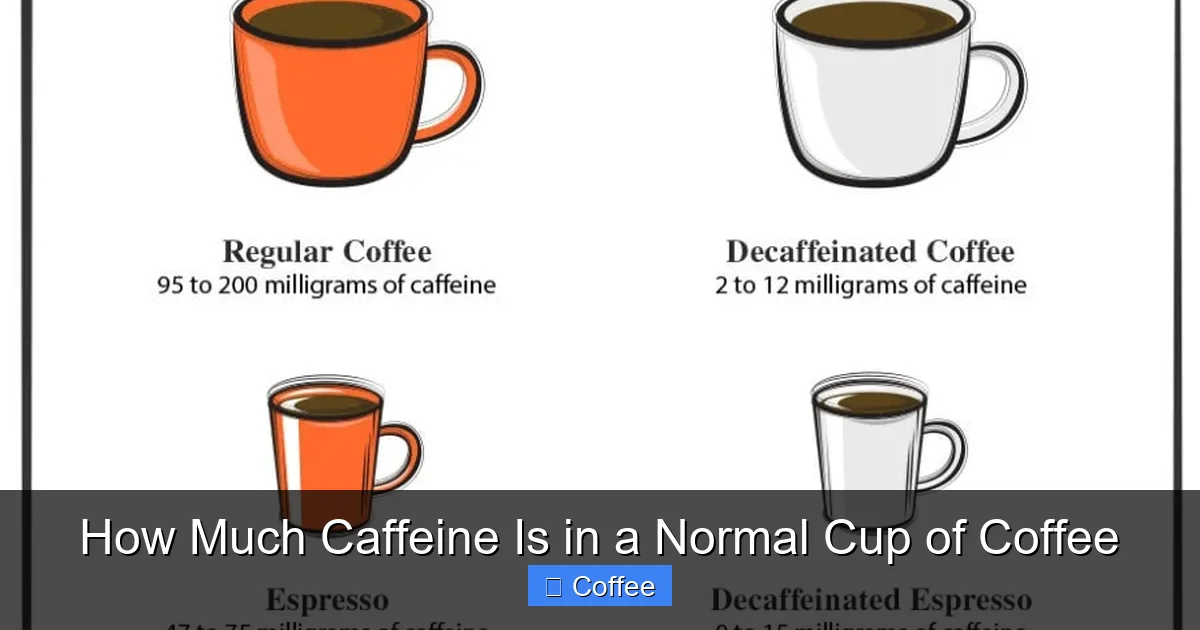
- Decaf isn’t zero: It still contains 2-15mg per cup—enough to affect sensitive people.
Quick Answers to Common Questions
Does coffee strength mean more caffeine?
Not necessarily. “Strong” usually refers to flavor intensity (bitterness), not caffeine. A dark roast can taste stronger but have slightly less caffeine than a light roast. Brew method matters more—French press extracts more caffeine than drip, even with the same beans.
Is cold brew stronger in caffeine?
Yes, but it’s misleading. Cold brew concentrate has very high caffeine (150-250mg per 8oz), but it’s typically diluted with water or milk before drinking. A standard 8oz serving of diluted cold brew still contains 100-150mg—more than drip coffee.
Why does decaf coffee keep me awake?
Decaf isn’t caffeine-free—it contains 2-15mg per cup. If you’re highly sensitive or drink large amounts, this can disrupt sleep. Also, the ritual of drinking coffee (even decaf) can trigger alertness through psychological association.
Can I build a tolerance to caffeine?
Absolutely. Regular consumption reduces caffeine’s effects—you’ll need more to feel the same buzz. Taking a 2-3 day break resets your sensitivity. This is why “coffee headaches” happen when you skip your morning cup.
Does adding milk reduce caffeine?
No. Milk dilutes the taste but doesn’t remove caffeine. A latte with two espresso shots still has ~125mg caffeine—the same as the espresso alone. Only using less coffee reduces caffeine.
📑 Table of Contents
What Does “Normal Cup of Coffee” Even Mean?
Hey there, coffee lover! Let’s cut through the confusion right away. When people ask, “How much caffeine is in a normal cup of coffee?” they’re usually imagining that steaming mug they grab every morning. But here’s the kicker: there’s no universal “normal” cup. What you consider a cup might shock you.
Most coffee drinkers pour 12oz or more into their favorite mug—that’s 50% bigger than the standard 8oz serving size used in nutrition labeling and caffeine studies. If you’re sipping a grande latte at your local café, you’re already consuming 16oz before the milk even hits the cup. This size mismatch is why so many people accidentally over-caffeinate themselves. The FDA and health organizations base their caffeine guidelines on an 8oz (240ml) cup of brewed coffee—not the giant thermos you take to work.
Why does this matter? Because caffeine isn’t just about wakefulness—it affects your heart rate, sleep quality, and anxiety levels. Knowing your actual intake helps you enjoy coffee without the 3 p.m. crash or midnight insomnia. In this guide, we’ll decode exactly how much caffeine you’re really getting, why it varies so much, and how to tweak your brew for the perfect buzz. No jargon, no fluff—just real talk from bean to cup.
The Bean Factor: Arabica vs. Robusta
Let’s start at the source: the coffee bean itself. Not all beans are created equal when it comes to caffeine content, and this is the biggest variable you can’t see once the coffee is ground.
Visual guide about How Much Caffeine Is in a Normal Cup of Coffee
Image source: coffeeabout.com
Arabica: The Smooth Operator
Arabica beans make up about 60-70% of global coffee production. They’re grown at higher altitudes, have a sweeter, more complex flavor, and—crucially—contain less caffeine. On average, Arabica beans pack 1.2-1.5% caffeine by weight. This lower caffeine content is actually why they’re preferred for specialty coffee—it allows their nuanced flavors to shine without bitterness. When you sip a pour-over from your local third-wave café, you’re almost certainly drinking Arabica. An 8oz cup of Arabica-based drip coffee typically lands between 70-90mg of caffeine.
Robusta: The Caffeine Powerhouse
Robusta beans are the unsung heroes of caffeine density. Grown at lower altitudes, they’re hardier plants with a stronger, more bitter taste—and they contain roughly 2.2-2.7% caffeine by weight. That’s nearly double the caffeine of Arabica! This is why Robusta is a staple in instant coffee, espresso blends (especially in Italy), and budget-friendly supermarket brands. If your coffee tastes intensely bold and slightly harsh, Robusta is likely doing the heavy lifting. An 8oz cup of pure Robusta brew can hit 100-200mg of caffeine—enough to make your heart race if you’re sensitive.
Real-world example: That affordable pre-ground coffee in your pantry? Check the label. If it says “100% Arabica,” you’re getting ~80mg per 8oz cup. But if it’s a “blend” (common in espresso mixes), it might contain 30-50% Robusta—pushing your caffeine to 100mg or more. Even small changes in bean ratio drastically alter your intake.
Roast Level: The Great Caffeine Myth
Here’s a fact that surprises most coffee drinkers: darker roasts actually have slightly less caffeine than lighter roasts. Yes, you read that right. That pitch-black espresso roast isn’t packing more caffeine—it’s just denser.
Visual guide about How Much Caffeine Is in a Normal Cup of Coffee
Image source: craftcoffeespot.com
Why Lighter Roasts Win (Slightly)
During roasting, coffee beans lose mass through moisture evaporation and chemical changes. Darker roasts are roasted longer, making them less dense and more brittle. When you measure coffee by volume (scoops), a dark roast takes up more space than a light roast for the same weight. But caffeine is measured by weight, not volume. So:
- Light roast (e.g., cinnamon roast): Denser bean = more caffeine per scoop. ~1.37% caffeine by weight.
- Dark roast (e.g., French roast): Less dense bean = fewer caffeine-rich cells per scoop. ~1.20% caffeine by weight.
The difference isn’t huge—about 5-10% less caffeine in a dark roast by weight. But since most people scoop coffee (not weigh it), you might actually get more caffeine from a dark roast if you use the same number of scoops. For example:
- 2 scoops of light roast (weighing 14g) = ~192mg caffeine
- 2 scoops of dark roast (weighing 12g) = ~144mg caffeine
However, many baristas and home brewers use more dark roast scoops to compensate for its weaker flavor, which can negate this difference. Bottom line: Roast level alone won’t make or break your caffeine intake—but it’s not the caffeine booster many assume.
The Flavor Trade-Off
While caffeine differences are minimal, roast level dramatically impacts taste. Light roasts retain more origin flavors (fruity, floral), while dark roasts develop smoky, chocolatey notes. If you love bold coffee but want less caffeine, try a medium roast Arabica—it balances flavor and moderate caffeine (~85mg per 8oz).
Brewing Methods: Your Caffeine Control Knob
This is where caffeine content gets truly wild. How you extract coffee from grounds changes everything—from a delicate pour-over to a pressurized espresso shot. Let’s break down the most common methods.
Visual guide about How Much Caffeine Is in a Normal Cup of Coffee
Image source: roastycoffee.com
Drip Coffee (The Everyday Standard)
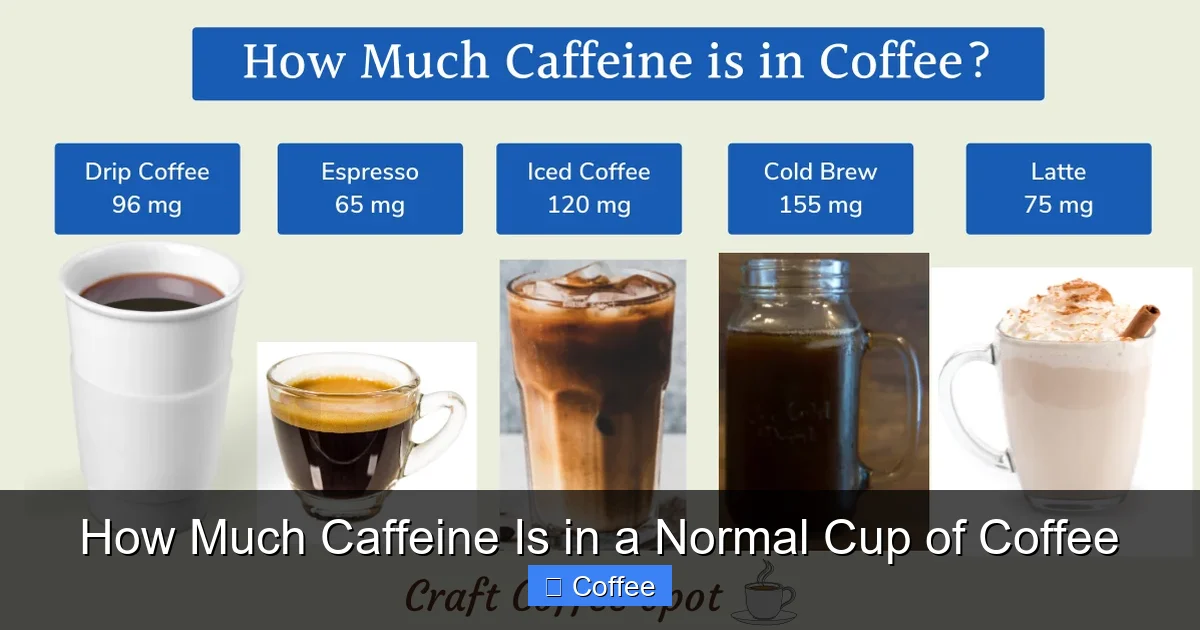
Your automatic coffee maker? That’s drip brewing. Water passes through grounds slowly, extracting caffeine steadily. An 8oz cup of standard drip coffee averages 80-100mg of caffeine. But watch out for these traps:
- Strong brew setting: Uses more grounds = 100-130mg per 8oz.
- Weak brew or “half-caff”: Dilutes to 40-60mg.
- Commercial “large” cups: A 16oz diner coffee can hit 160-200mg—double the “normal” cup!
Pro tip: Use a kitchen scale. For consistent 90mg caffeine, aim for 18g (2.5 tbsp) of medium-ground Arabica per 8oz water.
Espresso: Concentrated, Not Necessarily Higher
Espresso myths abound. Many think it’s “stronger” in caffeine, but a single 1oz (30ml) shot contains only 63mg of caffeine on average—less than drip coffee per ounce. Why? The short extraction time (25-30 seconds) limits caffeine pull. However:
- Double shots (2oz): ~125mg—comparable to 8oz drip coffee.
- Espresso blends: Often contain Robusta, pushing caffeine to 80mg per shot.
That latte you order? The espresso contributes most of the caffeine, while milk just dilutes it. A 16oz latte with two shots = ~125mg caffeine—similar to a large drip coffee.
French Press & Cold Brew: The Heavy Hitters
Immersion brewing (steeping grounds in water) extracts more caffeine because grounds aren’t rinsed away. Expect:
- French press (8oz): 100-150mg caffeine. Coarse grounds + 4-minute steep = maximum extraction.
- Cold brew (8oz concentrate): 150-250mg! Steeped 12-24 hours, it’s ultra-concentrated. Diluted with water/milk, it still packs 100-150mg per 8oz serving.
Caution: Cold brew’s smoothness hides its caffeine punch. That “easy-drinking” glass might be a double shot in disguise.
Instant Coffee: The Low-Key Option
Surprisingly, instant coffee is often lower in caffeine. A standard 8oz cup made from 1 tsp of powder contains 30-90mg, depending on brand and strength. Why? The freeze-drying process reduces caffeine content, and many people use less powder than ground coffee. It’s a great choice for sensitive folks or late-day sipping.
Health Impacts: How Much Is Too Much?
Knowing your caffeine number is useless without context. Let’s talk safe limits, side effects, and why your friend can drink five cups while you’re jittery after one.
The 400mg Rule (and Its Exceptions)
The FDA states that 400mg of caffeine per day is safe for most healthy adults—roughly 4-5 cups of drip coffee. But this isn’t one-size-fits-all. Factors that change your limit:
- Genetics: Some people metabolize caffeine slowly (CYP1A2 gene variant), making them prone to anxiety and insomnia even with small amounts.
- Pregnancy: OB-GYNs recommend under 200mg daily due to links to low birth weight.
- Medications: Caffeine interacts with antibiotics, thyroid meds, and anxiety drugs (e.g., MAOIs).
- Anxiety disorders: Even 100mg can trigger panic attacks in sensitive individuals.
Red flags you’ve had too much: Racing heart, restlessness, headache, or digestive upset. If you feel these after one cup, switch to half-caff or tea.
Caffeine Half-Life: Why Timing Matters
Caffeine isn’t a switch—it sticks around. Its half-life is 5-6 hours for most people. That means if you drink 100mg at 2 p.m., 50mg is still in your system at 8 p.m.—enough to disrupt sleep for slow metabolizers. To avoid 2 a.m. wakefulness:
- Stop caffeine 8-10 hours before bedtime.
- Replace afternoon coffee with chicory root or decaf (more on that soon).
- Hydrate well—caffeine is a diuretic, worsening dehydration headaches.
Fun fact: Smokers metabolize caffeine twice as fast as non-smokers. Quitting smoking? You might suddenly feel jittery with your usual coffee intake.
Practical Tips: Take Control of Your Caffeine
Now that you know the variables, here’s how to hack your brew for the perfect caffeine experience—whether you need a gentle nudge or a productivity rocket.
Measure Like a Pro (No Fancy Gear Needed)
Stop eyeballing scoops! Use these simple hacks:
- The tablespoon rule: 1 level tbsp of medium-ground coffee = ~10g = ~100mg caffeine for Arabica. Adjust for Robusta blends (+20-30mg).
- Water ratio: For 8oz water, use 2 tbsp (14g) for standard strength (80-90mg). Reduce to 1.5 tbsp for 60-70mg.
- Decaf swap: Blend 70% decaf + 30% regular for ~30mg caffeine—enough for habit without the buzz.
Real-life example: Maria, a nurse working night shifts, uses 1 tbsp of dark roast (Robusta blend) per 6oz water for a 70mg “maintenance” cup at 2 a.m.—enough to stay alert without crashing later.
Choose Your Brew for Your Goal
Match your method to your need:
- Gentle start (6-8 a.m.): Light roast pour-over (70mg) or green tea (30mg).
- Mid-morning boost (10 a.m.): Standard drip (85mg) or single espresso (63mg).
- Afternoon slump (2 p.m.): Cold brew diluted 1:1 with water (75mg) or matcha (70mg).
- Evening ritual (no caffeine): Chicory root “coffee” or roasted barley tea.
Pro move: If you love espresso but want less caffeine, ask for a “ristretto” shot—shorter extraction = 30-40mg instead of 63mg.
Decaf Isn’t the Enemy (But Know the Facts)
Decaffeinated coffee still contains caffeine—typically 2-15mg per 8oz cup. The decaf process (Swiss Water or CO2) removes 97% of caffeine, but not 100%. For most people, this is negligible. However:
- Ultra-sensitive folks: Stick to tea (white tea has 15mg) or herbal “coffee” alternatives.
- Pregnancy: Confirm decaf brand—some exceed 10mg. Swiss Water process is best.
- Taste tip: Dark roast decaf often tastes better—roasting mellows the chemical aftertaste.
Don’t fear decaf! It’s packed with antioxidants and perfect for afternoon sipping.
Conclusion: Your Coffee, Your Rules
So, how much caffeine is in a normal cup of coffee? As we’ve seen, it’s not a simple number—it’s a conversation between your beans, your brew method, and your body. That “normal” 8oz cup can range from a gentle 60mg (light roast Arabica, weak brew) to a wake-up call of 150mg (Robusta French press). The magic isn’t in chasing a universal standard—it’s in understanding your variables.
Remember: Coffee is personal. Your perfect cup might be a 12oz cold brew that fuels your morning run, or a delicate pour-over that pairs with sunrise meditation. The key is awareness—knowing that switching from drip to espresso changes your intake, or that your “large” café order is really two servings. Use this knowledge not to restrict yourself, but to craft a coffee ritual that energizes without exhausting.
Next time you brew, ask: “What does my body need today?” Maybe it’s 85mg of smooth drip coffee, or perhaps it’s time to try that chicory blend. However you sip, do it intentionally. Because the best cup of coffee isn’t the one with the most caffeine—it’s the one that makes you feel just right.
Frequently Asked Questions
What’s the absolute lowest caffeine coffee I can drink?
Swiss Water decaf is your best bet, with 2-5mg per 8oz cup. For non-coffee options, white tea (15mg) or roasted barley tea (0mg) work. Remember, even “caffeine-free” herbal teas can contain trace amounts—check labels if highly sensitive.
How does caffeine in coffee compare to energy drinks?
A 16oz energy drink averages 160-200mg caffeine—similar to a large (16oz) drip coffee. But energy drinks pack extra stimulants (taurine, guarana) and sugar, amplifying side effects. Coffee offers a purer caffeine experience with antioxidants.
Can I drink coffee while pregnant?
Yes, but limit to 200mg daily (about two 8oz cups of drip coffee). Avoid espresso shots and cold brew—they’re harder to dose accurately. Always consult your OB-GYN, as individual risk factors vary.
Why do I feel anxious after coffee?
Caffeine blocks adenosine (a calming neurotransmitter) and increases adrenaline. If you’re sensitive, even 50mg can cause jitters. Try switching to half-caff, drinking water with coffee, or choosing Arabica over Robusta blends.
Does grinding coffee fresh increase caffeine?
No—caffeine content is fixed in the bean. Fresh grinding improves flavor by preserving oils, but doesn’t change caffeine levels. Pre-ground coffee loses aroma faster but has identical caffeine per gram.
How long before bed should I avoid coffee?
Aim for 8-10 hours before bedtime. Since caffeine’s half-life is 5-6 hours, drinking at 2 p.m. leaves 25-50mg in your system at 10 p.m.—enough to fragment sleep for many people. If you’re a slow metabolizer, stop by noon.