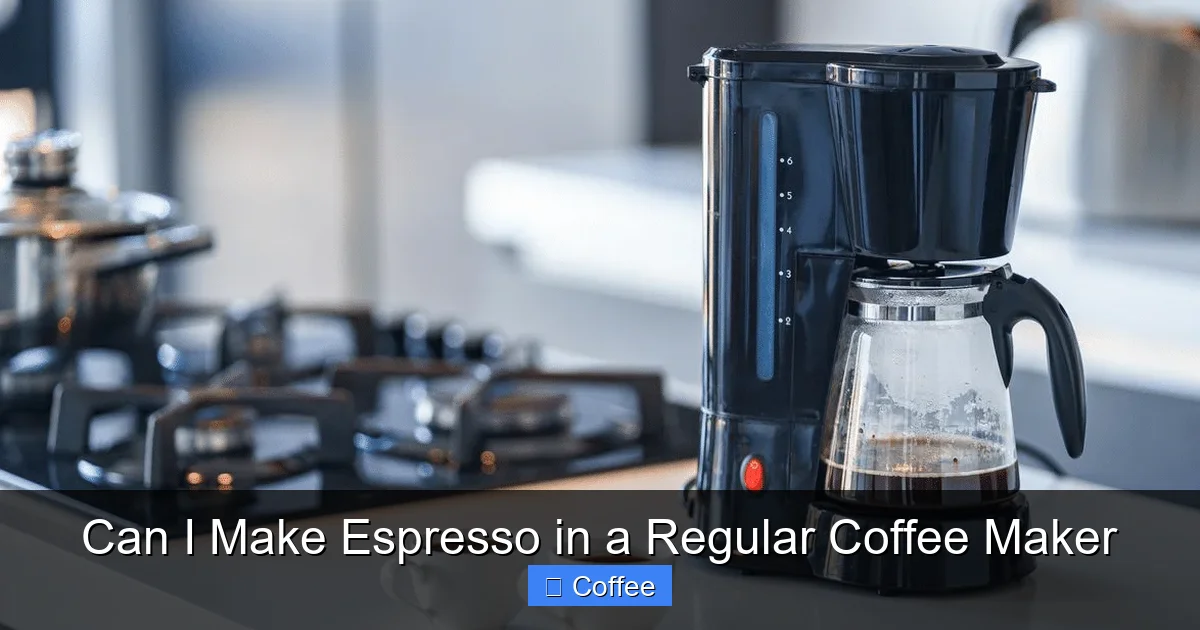
You cannot make true espresso in a standard drip coffee maker because it lacks the essential 9-bar pressure required. While you can brew very strong, concentrated coffee that *resembles* espresso in strength and appearance, it will miss the signature crema, intense flavor profile, and body of real espresso. For authentic espresso, you need a dedicated machine, but budget-friendly alternatives like Moka pots or French press hacks offer satisfying approximations.
Key Takeaways
- True espresso requires high pressure (9 bars): Standard drip coffee makers use gravity or low pressure (1-2 bars), fundamentally incapable of producing real espresso.
- Drip makers make strong coffee, not espresso: You can brew a highly concentrated “espresso-style” shot, but it lacks crema, has different flavor extraction, and a thinner body.
- Moka pots are the best budget alternative: Stovetop Moka pots use steam pressure (1-2 bars) to create a strong, rich coffee concentrate much closer to espresso than drip methods.
- French press can mimic texture: Using a fine grind and short steep time in a French press yields a bold, full-bodied coffee with some sediment mimicking espresso’s mouthfeel.
- Grind size and coffee-to-water ratio are critical: For any approximation, use a fine grind (like table salt) and a very high coffee-to-water ratio (e.g., 2:1 or 3:1).
- Manage expectations: Don’t expect cafe-quality espresso from a drip maker; focus on making delicious strong coffee for lattes or sipping.
- Consider your goals: If you crave authentic espresso daily, invest in a dedicated machine (manual, capsule, or automatic). For occasional strong coffee, alternatives work well.
Quick Answers to Common Questions
Will coffee brewed this way in a drip maker taste exactly like espresso?
No, it won’t taste exactly like espresso. While it will be much stronger and more concentrated than regular drip coffee, it will lack the signature crema, have a different flavor profile (often more bitter or thinner), and miss the complex balance of a true 9-bar pressure extraction.
Can I use espresso roast beans in my drip maker for this “espresso-style” brew?
Yes, absolutely! Using espresso roast beans (which are typically darker roasted) is actually recommended for this method. The darker roast complements the intense concentration and can help reduce some potential harshness compared to using a light roast at such a high strength.
Is there a risk of damaging my drip coffee maker by trying to make “espresso-style” coffee?
Yes, there is a risk. Using a very fine grind and a high dose of coffee can easily clog the filter or the machine’s internal tubes, especially if the machine isn’t designed for it. It can also lead to overheating elements if brewing such a small volume. Proceed with caution and be prepared for potential maintenance issues.
What’s the biggest difference I’ll notice between drip “espresso” and real espresso?
The most noticeable differences are the absence of crema (that golden foam) and the body/texture. Real espresso has a thick, syrupy mouthfeel. Drip “espresso” tends to be thinner and lacks that luxurious texture, even if it’s very strong. The flavor complexity is also usually less balanced.
For making lattes at home, is the strong drip brew “good enough”?
Yes, for many people, it is perfectly “good enough,” especially when combined with steamed milk. The milk helps mask some of the potential harshness or thinness of the drip brew and adds the body that real espresso provides. It’s a practical and cost-effective solution for enjoying homemade lattes without an espresso machine.
📑 Table of Contents
- The Dream vs. The Reality: Espresso in Your Drip Machine?
- What Actually Makes Espresso… Espresso?
- How a Regular Drip Coffee Maker Actually Works
- Can You *Approximate* Espresso in a Drip Maker? (The Strong Coffee Hack)
- Better Alternatives: Getting Closer to Espresso Without a Dedicated Machine
- When Should You Actually Buy an Espresso Machine?
- Conclusion: Embrace What Your Brewer Can Do
The Dream vs. The Reality: Espresso in Your Drip Machine?
Picture this: You’re craving that rich, velvety shot of espresso. Maybe you want to whip up a latte, a cappuccino, or just savor a small, intense cup. You glance at your trusty drip coffee maker, humming quietly on the counter. It makes great morning coffee, so surely it can handle espresso too, right? It seems like a logical shortcut – no need for another expensive appliance. You might even think, “Can I make espresso in a regular coffee maker?” It’s a question countless coffee lovers ask, hoping for a simple solution.
The allure is undeniable. Espresso machines, especially quality ones, can be a significant investment. Your drip maker is already there, familiar, and ready to go. The idea of repurposing it feels smart and economical. But here’s the crucial truth we need to unpack: the fundamental mechanics of how espresso is made are completely different from how a standard drip coffee maker works. Understanding this difference is key to knowing why your drip machine, despite its best efforts, simply cannot produce authentic espresso. It’s not about effort or clever hacks; it’s about physics and engineering.
What Actually Makes Espresso… Espresso?
Before we dive into why your drip maker falls short, let’s clarify what defines real espresso. It’s not just “strong coffee.” Espresso is a specific brewing method defined by three critical elements working together:
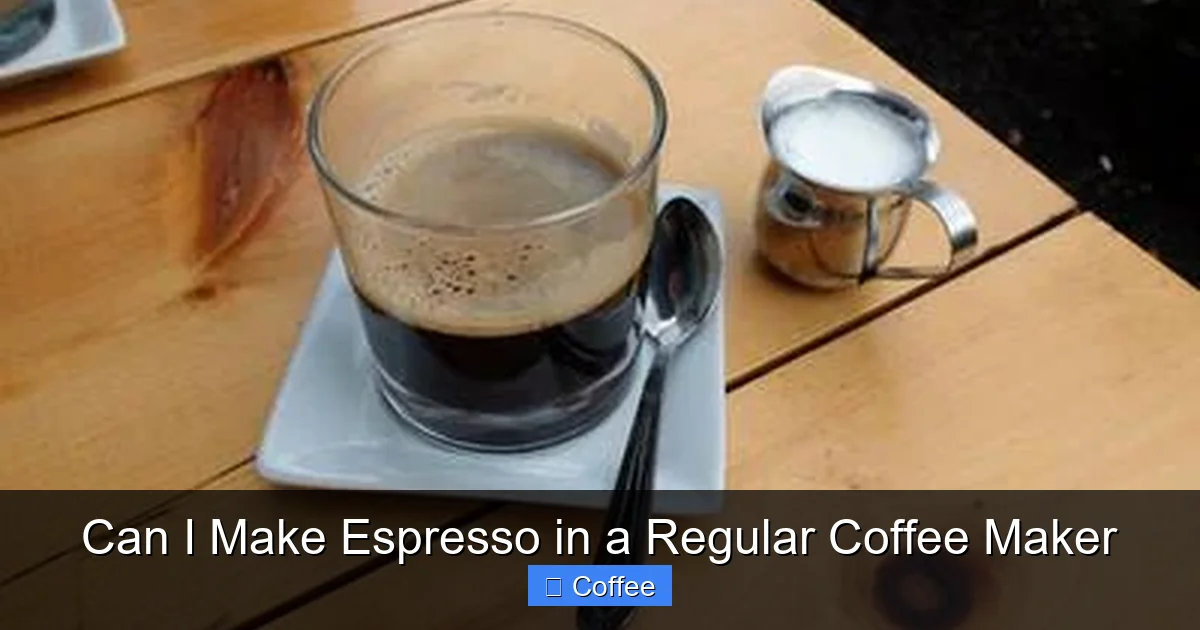
Visual guide about Can I Make Espresso in a Regular Coffee Maker
Image source: coffeedetective.com
The Non-Negotiable: 9 Bars of Pressure
This is the absolute cornerstone. True espresso requires forcing hot water (around 195-205°F or 90-96°C) through a tightly packed puck of finely ground coffee using approximately 9 bars (130 psi) of pressure. This intense pressure is what achieves the unique extraction. It rapidly dissolves the coffee solids, oils, and gases, creating that signature concentrated liquid. Crucially, it also emulsifies the coffee oils and traps carbon dioxide, forming the prized, golden-brown layer on top called crema. This crema isn’t just foam; it’s a sign of proper extraction and contributes significantly to espresso’s texture and flavor. No 9-bar pressure? No true espresso. It’s that simple.
Fine Grind & Precise Dose
Espresso demands a very fine grind, almost like powdered sugar or flour. This fine particle size creates resistance. When packed correctly into the portafilter basket (the “puck”), this resistance is what allows the high pressure to build up and force the water through the coffee bed evenly. Using a coarse grind, like you would for drip, would let water flow through too quickly under pressure, resulting in a weak, under-extracted shot. The dose (amount of coffee) and the yield (amount of liquid espresso) are also precisely measured, typically aiming for a 1:2 ratio (e.g., 18g coffee yielding 36g espresso) over 25-30 seconds.
The Result: Concentration & Complexity
The combination of high pressure, fine grind, and precise timing extracts coffee differently than immersion or drip methods. Espresso is incredibly concentrated (about 8-10% dissolved solids vs. 1-2% for drip), delivering intense flavors, a syrupy body, and that essential crema. It captures a broader spectrum of coffee compounds, including desirable oils and aromatic gases, resulting in a complex, layered taste profile that’s fundamentally different from even the strongest drip coffee. It’s a unique beverage, not just a scaled-down version of regular coffee.
How a Regular Drip Coffee Maker Actually Works
Now, let’s contrast this with your standard automatic drip coffee maker – the kind with a water reservoir, a heating element, a filter basket, and a carafe. Understanding its process reveals why it’s fundamentally incompatible with espresso production.

Visual guide about Can I Make Espresso in a Regular Coffee Maker
Image source: static.vecteezy.com
Gravity-Powered (Mostly) Brewing
The core mechanism of a drip maker is relatively simple and relies primarily on gravity and low pressure. Here’s the flow: Cold water sits in the reservoir. When you turn it on, an electric heating element heats this water. The hot water then travels up a tube (often via a thermosiphon effect or a small pump in some models) and drips slowly onto the coffee grounds sitting in a paper or metal filter. The brewed coffee then drips down through the filter into the carafe below, pulled by gravity. The entire process is relatively slow, typically taking 5-10 minutes for a full pot.
The Pressure Problem (or Lack Thereof)
This is where the dream of drip-made espresso hits the wall. Drip coffee makers operate at very low pressure – usually just 1-2 bars (15-30 psi), and often effectively just atmospheric pressure (1 bar). The water isn’t being *forced* through the coffee under high pressure; it’s simply *dripping* through due to gravity. There’s no mechanism to generate or sustain the 9 bars needed for espresso extraction. The heating element gets the water hot, but it doesn’t create the intense pressure required to emulsify the oils and create crema. The water flow rate is also much slower than the rapid 25-30 second extraction time of espresso.
Designed for Dilution, Not Concentration
Drip makers are engineered to produce a specific volume of coffee (e.g., 8-12 cups) using a standard coffee-to-water ratio (typically around 1:16 or 1:17, meaning 1 part coffee to 16-17 parts water). Their entire design – the size of the filter basket, the flow rate of the water, the heating capacity – is optimized for brewing this larger volume of lighter-bodied coffee. They lack the precision, pressure, and speed needed to create a small, intensely concentrated shot. Trying to force concentration by using more coffee or less water fundamentally breaks the machine’s intended function and often leads to over-extraction, bitterness, or clogging.
Can You *Approximate* Espresso in a Drip Maker? (The Strong Coffee Hack)
So, while you absolutely cannot make true espresso in a regular drip coffee maker, you *can* use it to brew a very strong, concentrated coffee that resembles espresso in strength and appearance. This is often called “espresso-style” coffee or a “ristretto-style” brew. It’s not espresso, but it can be a useful substitute for certain purposes, like making lattes or Americanos when you don’t have an espresso machine.

Visual guide about Can I Make Espresso in a Regular Coffee Maker
Image source: roastycoffee.com
The Method: Maximizing Strength
The goal is to extract as much flavor as possible into the smallest volume of water. Here’s how to hack your drip maker:
- Use WAY more coffee: Forget the standard “scoops per cup” guideline. For a single “shot” (about 1-2 oz or 30-60ml), you might use 2-3 tablespoons (15-25g) of coffee. For a double shot, 4-6 tablespoons (30-50g). This is a very high coffee-to-water ratio, often 1:2 or even 1:1.
- Use a fine grind: Switch from your usual drip grind (medium) to a much finer grind, closer to what you’d use for espresso or a Moka pot (like table salt). This increases surface area for extraction.
- Use less water: Only fill the reservoir with the minimal amount of water needed to brew your desired shot size (e.g., 2-4 oz). This forces the machine to push that small amount of water through a large amount of coffee.
- Use a smaller filter basket (if possible): Some machines have removable baskets. Using a smaller basket (or even a paper filter folded to fit a smaller area) concentrates the coffee bed.
- Brew directly into your cup: Place your preheated espresso cup or small mug directly under the drip spout instead of the carafe. This catches the concentrated brew immediately.
What You Get (and What You Don’t)
Following this method will produce a dark, strong, intensely flavored liquid. It will be much more concentrated than regular drip coffee. However, it will lack the defining characteristics of espresso:
- No Crema: Without 9 bars of pressure, the coffee oils won’t emulsify, and CO2 won’t be trapped. You’ll get a dark liquid, but no golden foam on top.
- Different Flavor Profile: Extraction happens differently. Drip brewing is primarily percolation (water flowing through grounds), while espresso is a rapid, pressure-driven dissolution. The strong drip brew might taste more bitter or astringent (from over-extraction of certain compounds) and lack the complex sweetness and balance of well-pulled espresso. It often has a thinner body.
- Inconsistent Results: Drip machines aren’t designed for this. Flow rates vary, heating might not be optimal for such a small volume, and clogging is a real risk with fine grinds and high coffee doses. Getting a consistent “shot” is challenging.
Best Use Case: This strong brew is excellent for making Americanos (adding hot water) or as the base for lattes and cappuccinos where the milk helps mask some of the potential harshness and adds body. It’s a functional substitute for *some* espresso applications, but purists will notice the difference.
Better Alternatives: Getting Closer to Espresso Without a Dedicated Machine
If your goal is to make something genuinely closer to espresso at home without investing in a $300+ machine, your drip maker isn’t the best tool. Fortunately, there are much more effective budget-friendly alternatives that leverage different principles to achieve that concentrated, rich result.
The Moka Pot: The Stovetop Champion
The Moka pot is arguably the single best alternative for making espresso-like coffee at home on a budget. It’s a stovetop brewer consisting of three chambers: a bottom for water, a middle for coffee grounds, and a top for the brewed coffee. Here’s why it wins:
- Steam Pressure: As the water in the bottom chamber heats, it turns to steam. This steam creates pressure (typically 1-2 bars, higher than drip but lower than true espresso) that forces the hot water up through the coffee grounds and into the top chamber. This pressure-driven extraction is fundamentally closer to espresso than drip.
- Concentrated Result: Moka pot coffee is strong, rich, and full-bodied. While it lacks true crema (though some models produce a slight froth), it has a viscosity and intensity much closer to espresso than drip coffee. It’s often called “stovetop espresso.”
- Affordability & Simplicity: A good quality Moka pot (like Bialetti) costs $20-$40, is incredibly durable, easy to use, and requires no electricity beyond your stove. It’s a one-time purchase that lasts decades.
- How to Use It: Fill the bottom with hot water (just below the valve), add finely ground coffee to the filter basket (don’t tamp hard!), screw the top on tightly, and place it on medium heat. As it brews, you’ll hear a gurgling sound – remove it from heat once this sound becomes rapid and violent to avoid bitterness. Yields about 1-3 strong “shots” per brew.
Why it’s better than drip for espresso-like coffee: The pressure-driven extraction mimics the core mechanism of espresso far more closely than gravity drip. The result is significantly richer, more concentrated, and closer in character to actual espresso.
French Press: The Immersion Contender
While a French press is an immersion brewer (like pour-over, but full immersion), it can be hacked to produce a very strong, full-bodied coffee that approximates espresso’s mouthfeel, especially when used for milk drinks.
- The Hack: Use a very fine grind (almost espresso fine, but be prepared for sediment). Use a very high coffee-to-water ratio – think 1:2 or 1:3 (e.g., 30g coffee to 60-90ml water). Preheat the press. Add coffee, then just enough near-boiling water to saturate it (bloom). Stir gently. Add the remaining water. Place the lid with the plunger *up*, and steep for only 1-2 minutes (instead of the usual 4). Plunge very slowly and steadily.
- What You Get: This produces an intensely strong, bold coffee with significant body and a lot of fine sediment. The sediment contributes to a thicker, more syrupy mouthfeel reminiscent of espresso. It lacks pressure and crema, but the concentration and texture are closer than drip.
- Best For: Making lattes or cappuccinos where the milk integrates with the strong coffee and sediment. Sipping it straight is very intense and may be too harsh for some.
- Caveats: Sediment means it’s not “clean” like espresso. Consistency can be tricky. Over-extraction/bitterness is easy if steep time is too long.
Why it’s better than drip for espresso-like coffee: The fine grind and short steep time maximize extraction efficiency into a small volume, creating much greater concentration and body than any drip method can achieve. The immersion also extracts different compounds, contributing to richness.
AeroPress: The Versatile Powerhouse
The AeroPress is a manual press brewer known for its speed, versatility, and ability to make incredibly clean, strong coffee. While not pressure-driven like espresso, its unique design allows for excellent concentration.
- The Espresso-Style Method: Use a fine grind. Invert the AeroPress (plunger down, chamber up). Add coffee (e.g., 15-18g). Add a small amount of hot water (e.g., 30-50ml) to saturate and bloom for 10-15 seconds. Stir vigorously for 5-10 seconds. Add remaining water to reach your desired total volume (e.g., 60-90ml total). Attach filter cap. After 1 minute total steep time, press slowly and steadily (takes 20-30 seconds).
- What You Get: A very clean, smooth, intensely flavored concentrate. While it lacks the body and crema of espresso, the flavor clarity and strength are impressive. Many baristas use it to make “AeroPress espresso” for milk drinks. The slow press creates some pressure, aiding extraction.
- Advantages: Fast (2-3 minutes total), portable, durable, easy to clean, produces very clean coffee with minimal sediment. Highly customizable.
- Best For: A clean, strong concentrate ideal for Americanos or as a base for milk drinks where clarity is valued. Less “syrupy” than Moka pot or French press hacks.
Why it’s better than drip for espresso-like coffee: The ability to control grind, ratio, water temperature, and steep time precisely, combined with the gentle pressure of the press, allows for optimal extraction into a small volume, far surpassing drip capabilities.
When Should You Actually Buy an Espresso Machine?
We’ve established that your drip maker won’t cut it for true espresso, and alternatives like Moka pots are great. But how do you know if it’s time to invest in a dedicated espresso machine? It boils down to your expectations, usage, and budget.
You’re Serious About Espresso (Daily Drinker)
If you drink espresso or espresso-based drinks (lattes, cappuccinos) every single day, and you crave that authentic cafe experience at home – the crema, the specific flavor profile, the ritual – then a real espresso machine is worth the investment. The difference in quality, consistency, and enjoyment is substantial. Think of it as upgrading from a basic sedan to a sports car if you drive daily; the experience matters.
You Value Consistency and Convenience
Dedicated espresso machines (even entry-level ones) are engineered for one purpose: pulling consistent shots. They maintain precise temperature and pressure. Once dialed in, you get reliable results every time. While Moka pots are great, they require more attention and technique to get consistent results. If you want “set it and forget it” reliability for your morning latte, a machine delivers.
You Want the Full Experience (Including Milk Frothing)
Making good milk-based espresso drinks requires two things: a good shot of espresso and properly steamed milk. Entry-level espresso machines come with steam wands designed specifically for this task. While you can froth milk with a French press, Moka pot, or handheld frother, it’s not the same as the microfoam created by a steam wand. If lattes and cappuccinos are your main goal, a machine with a steam wand is essential for the best results.
Budget Considerations: Where to Start
Espresso machines range wildly:
- Manual Lever/Pump (Entry-Level): $300-$600 (e.g., Rancilio Silvia, Gaggia Classic). Require skill but offer great control and quality. Best value for serious beginners.
- Capsule Machines (Convenience): $100-$300 (e.g., Nespresso). Consistent, easy, but expensive per shot and limited customization. Good for simplicity.
- Superautomatics (All-in-One): $600-$2000+. Grind, dose, tamp, brew, and froth automatically. Ultimate convenience, highest cost.
Recommendation: If you’re committed to daily espresso, start with a reputable entry-level manual/pump machine ($300-$500). It’s the best balance of quality, control, and value. Avoid ultra-cheap “espresso makers” under $200 – they rarely produce true espresso and break quickly.
When Alternatives Are Perfectly Sufficient
Don’t feel pressured to buy a machine if:
- You only occasionally want a strong coffee for a latte (Moka pot or French press hack is ideal).
- You primarily drink black coffee and only *sometimes* crave espresso (alternatives work great).
- Your budget is tight, and $300+ is a significant stretch (a $30 Moka pot is a fantastic tool).
- You value simplicity and minimal counter space (a Moka pot or AeroPress is compact).
Honest Assessment: Be realistic about how often you’ll truly use a machine and how much you value the *authentic* espresso experience versus just a strong coffee base. For many home brewers, a Moka pot provides 80-90% of the satisfaction at 10% of the cost.
Conclusion: Embrace What Your Brewer Can Do
So, can you make espresso in a regular coffee maker? The definitive answer is **no**. The physics of espresso – that essential 9-bar pressure – is simply impossible to achieve with the gravity-driven, low-pressure mechanics of a standard drip machine. Trying to force it results in strong coffee, not espresso. It might look dark and concentrated, but it will lack the soul of real espresso: the crema, the complex balanced flavor, the syrupy body.
But here’s the good news: **your drip coffee maker is still a fantastic tool for what it’s designed to do – brew delicious, everyday coffee.** And if you’re craving that intense, concentrated kick often associated with espresso, you have excellent alternatives right at your fingertips. The humble Moka pot, a stovetop staple for decades, is your absolute best bet for making rich, espresso-like coffee without breaking the bank. The French press, with a few tweaks, can deliver surprising body and strength. Even the AeroPress offers a clean, potent concentrate.
The key is managing expectations and working *with* your equipment, not against it. Don’t try to make your drip machine do something it fundamentally can’t. Instead, appreciate it for brewing a great pot of coffee, and reach for a Moka pot when you want that bolder, more concentrated experience. If you find yourself truly falling in love with the ritual and taste of authentic espresso, then it might be time to explore the wonderful world of dedicated espresso machines. But for most home coffee lovers, understanding the limits of your drip maker and embracing the simplicity of a Moka pot is the smartest, most satisfying path to great coffee at home. Brew what you have, enjoy the process, and know that true espresso has its own special magic – and its own special machine.
Frequently Asked Questions
Why can’t a drip coffee maker create the pressure needed for espresso?
Drip coffee makers rely on gravity and minimal internal pressure (usually just 1-2 bars) to move water through the coffee bed. They lack the powerful pump or lever mechanism required to generate and sustain the consistent 9 bars of pressure essential for forcing water through finely ground coffee quickly and creating emulsified crema.
Can I add something to my drip maker to increase pressure?
No, you cannot safely or effectively modify a standard drip coffee maker to generate espresso-level pressure. Attempting to do so could damage the machine, create safety hazards (like steam leaks or explosions), and void any warranty. The fundamental design isn’t built for it.
Is the coffee from a Moka pot considered real espresso?
No, Moka pot coffee is not technically espresso. While it uses steam pressure (around 1-2 bars) to create a strong, concentrated brew that resembles espresso, it doesn’t reach the 9-bar pressure standard. It lacks true crema and has a slightly different flavor profile, but it’s the closest common stovetop alternative.
What’s the easiest way to get espresso-like coffee at home cheaply?
The easiest and most affordable way is to use a stovetop Moka pot. For $20-$40, it produces a rich, concentrated coffee that works well for sipping or as a base for lattes and Americanos, offering the best approximation of espresso without a dedicated machine.
Can I use pre-ground espresso in my drip maker for stronger coffee?
Yes, you can use pre-ground espresso (which is very fine) in your drip maker, especially when attempting the “espresso-style” hack. However, the fine grind significantly increases the risk of clogging your machine. Use it sparingly and be prepared for potential cleaning challenges.
Do I need a special filter for making strong coffee in a drip maker?
Using a standard paper filter is fine, but a gold-toned permanent metal filter can sometimes allow more coffee oils to pass through, adding body to your strong brew. However, the metal filter also increases the risk of fine grounds ending up in your cup and doesn’t solve the fundamental pressure limitation of the drip maker.