
How Much Caffeine in a Large Mcdonalds Iced Coffee? A large McDonald’s Iced Coffee contains approximately 330mg of caffeine. This is significantly higher than many expect and approaches the daily recommended limit for most adults. Understanding this helps you manage your intake and avoid unwanted side effects like jitters or sleep issues.
Key Takeaways
- 330mg is the Standard: A large (30 fl oz) McDonald’s Iced Coffee packs roughly 330mg of caffeine, based on their standard brewed coffee recipe.
- It’s a Major Daily Dose: This single drink provides about 82% of the FDA’s suggested 400mg daily caffeine limit for healthy adults.
- Surprisingly High Compared: It contains more caffeine than a 16oz energy drink (like Monster Ultra at 150mg) and significantly more than a 12oz soda (30-40mg).
- Health Impacts Matter: Consuming this amount, especially later in the day or on an empty stomach, can cause anxiety, rapid heartbeat, or disrupt sleep for sensitive individuals.
- Customization is Key: You can reduce caffeine by ordering a smaller size, adding decaf shots, or choosing McDonald’s Cold Brew (which has even more caffeine).
- Know Your Limits: Most adults should stay under 400mg daily. Pregnant women and those with anxiety should aim for much less (under 200mg).
- Timing is Crucial: Drinking a large iced coffee after 2 PM significantly increases the risk of nighttime sleep problems.
Quick Answers to Common Questions
Is a large McDonald’s Iced Coffee stronger than a large Starbucks Iced Coffee?
Yes, generally. A large (30oz) McDonald’s Iced Coffee has about 330mg caffeine, while a large (Venti, 24oz) Starbucks Iced Coffee (brewed) has about 235mg. McDonald’s large size is bigger *and* has more caffeine per ounce.
Can I get a large McDonald’s Iced Coffee with less caffeine?
Your best options are to order a smaller size (medium has 240mg, small has 180mg) or choose the Decaf Iced Coffee (only 10-15mg). Asking for “less coffee” isn’t reliable and significantly alters the drink.
How long does the caffeine from a large McDonald’s Iced Coffee last?
Caffeine’s effects peak within 15-45 minutes. The half-life is about 5-6 hours, meaning it takes that long to eliminate half the 330mg. Significant amounts can remain in your system for 10+ hours, potentially disrupting sleep if consumed late.
Is McDonald’s Cold Brew stronger than their regular Iced Coffee?
Yes, significantly. McDonald’s Cold Brew is made differently and concentrates more caffeine. A large Cold Brew typically contains 350mg-400mg+, which is *more* than the 330mg in the regular large Iced Coffee.
What happens if I drink two large McDonald’s Iced Coffees in a day?
You’d consume approximately 660mg of caffeine – well over the FDA’s 400mg daily limit. This drastically increases the risk of severe side effects like anxiety, rapid heartbeat, digestive upset, and almost certainly guarantees significant sleep disruption.
📑 Table of Contents
- That Giant Cup of Cool: Unpacking the Caffeine Punch in McDonald’s Large Iced Coffee
- The Straight Answer: How Much Caffeine is Actually in a Large McDonald’s Iced Coffee?
- Putting 330mg in Perspective: How Does It Compare?
- What Does 330mg of Caffeine Actually Do to Your Body?
- Managing Your McDonald’s Iced Coffee Habit: Smart Strategies
- Beyond the Numbers: The Bigger Picture of Caffeine Awareness
- Conclusion: Sip Smart, Stay Energized
That Giant Cup of Cool: Unpacking the Caffeine Punch in McDonald’s Large Iced Coffee
Picture this: It’s a sweltering afternoon. You’re cruising through the drive-thru, craving something cold, sweet, and caffeinated to power through the rest of your day. You order a large McDonald’s Iced Coffee. It arrives, a tall, frosty cup promising refreshment and a kick. You take a long sip, the sweet, creamy coffee hitting the spot perfectly. But have you ever stopped to wonder, just how much caffeine are you actually gulping down with that large size? It’s a question more people are asking as they become more mindful of their caffeine intake and its effects on their health and sleep. The answer might surprise you – it’s a substantial dose, one that demands respect and awareness.
McDonald’s Iced Coffee is a staple for millions seeking a convenient, affordable caffeine fix. Its popularity stems from its consistent taste, accessibility, and that perfect balance of coffee, milk, and sweetness. However, the convenience often overshadows a critical detail: the caffeine content, especially in the large size. Unlike a simple black coffee you might brew at home where you control the strength, chain coffee drinks can be caffeine powerhouses. Understanding exactly how much caffeine is in your large McDonald’s Iced Coffee isn’t just trivia; it’s essential knowledge for managing your energy levels, avoiding afternoon crashes, and protecting your long-term health. Ignoring this can lead to unintended consequences like anxiety, disrupted sleep patterns, or even dependence. So, let’s dive deep into the numbers, the science, and the practical implications of that large cup.
The Straight Answer: How Much Caffeine is Actually in a Large McDonald’s Iced Coffee?

Visual guide about How Much Caffeine in a Large Mcdonalds Iced Coffee
Image source: snicecafe.com
Let’s cut to the chase. Based on McDonald’s official nutritional information and consistent reporting across their platforms and reputable third-party sources like the USDA FoodData Central, **a large (30 fluid ounce) McDonald’s Iced Coffee contains approximately 330 milligrams (mg) of caffeine.** This is the standard figure for their classic brewed coffee base used in the iced version. It’s crucial to understand that this number represents the *typical* amount. While McDonald’s aims for consistency, minor variations can occur due to factors like the specific coffee bean blend used that day, the exact brewing time and temperature at the individual restaurant, and even the water quality. However, 330mg is the reliable benchmark you can expect.
Why 330mg? Understanding the Source
This caffeine comes entirely from the brewed coffee used as the base for the iced drink. McDonald’s uses a specific coffee blend (often a medium roast) brewed to their standard strength. The large size contains a significant volume of this brewed coffee, diluted slightly by ice and mixed with milk and sweetener. Unlike some specialty coffee shops that might use concentrated cold brew (which typically has *more* caffeine), McDonald’s Iced Coffee is made from traditionally brewed hot coffee that’s then chilled. The brewing process extracts caffeine from the coffee grounds, and the large volume means a large amount of coffee was used, hence the high caffeine yield. Think of it as roughly equivalent to drinking about 3.3 cups of a standard 8oz home-brewed cup of coffee (which averages 95mg per cup), all in one convenient, cold package.
Size Matters: Comparing McDonald’s Iced Coffee Sizes
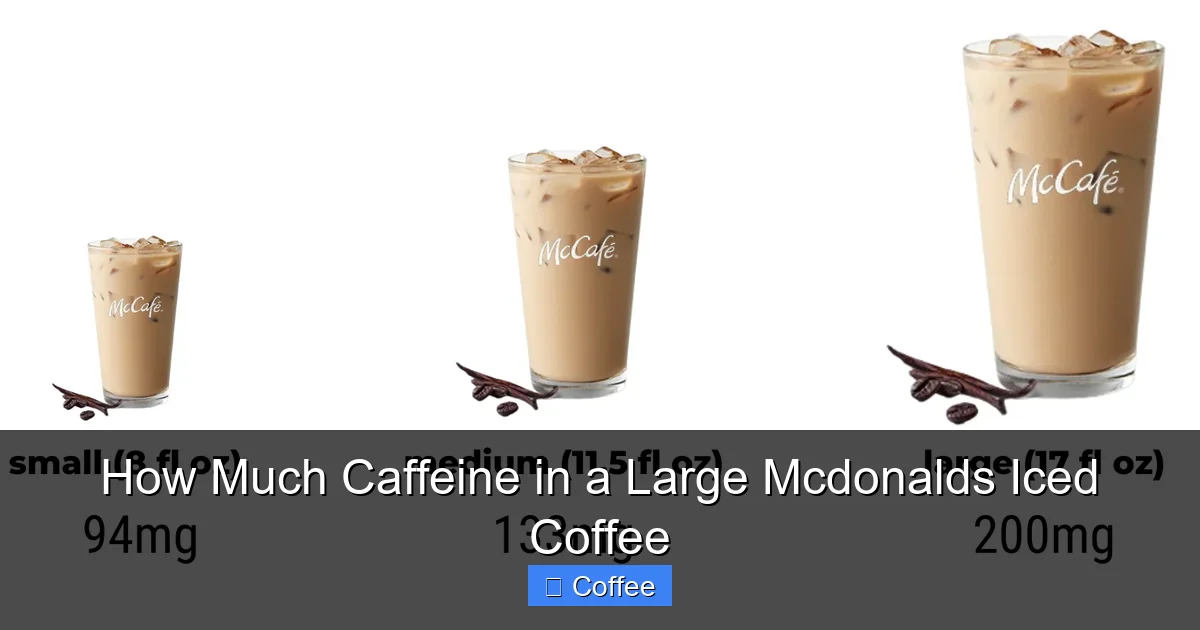
The caffeine content scales directly with the size of the drink. Here’s a quick breakdown for context:
* **Small (16 fl oz):** Approximately 180mg caffeine
* **Medium (22 fl oz):** Approximately 240mg caffeine
* **Large (30 fl oz):** Approximately 330mg caffeine (our focus)
* **Extra Large (36 fl oz – availability varies):** Approximately 400mg+ caffeine
Choosing a large means you’re consuming nearly double the caffeine of a small and significantly more than a medium. It’s easy to underestimate how much you’re actually getting when you opt for the largest size, especially if you’re also having other caffeinated items like soda or tea throughout the day.
Important Caveats and Variations
While 330mg is the standard, be aware of a few nuances:
1. **Regional Differences:** Nutritional information can sometimes vary slightly by country or region due to different coffee blends or regulations. Always check the local McDonald’s nutrition guide if available.
2. **Customizations:** Adding extra shots of espresso (if offered) will *dramatically* increase the caffeine content – each shot adds roughly 70-100mg. Conversely, ordering it “light” on coffee (more milk/ice) might slightly reduce it, but this isn’t standard and the reduction is minimal.
3. **Cold Brew Option:** McDonald’s now offers Cold Brew Coffee in many locations. **Crucially, their Cold Brew typically contains *more* caffeine than the regular Iced Coffee.** A large Cold Brew often ranges from 350mg to over 400mg. If you’re specifically looking to *reduce* caffeine, the standard Iced Coffee is slightly lower than Cold Brew, but both are very high.
4. **Decaf Option:** McDonald’s does offer decaffeinated coffee. A large Decaf Iced Coffee contains only about 10-15mg of caffeine – a negligible amount for most people. This is the clear path to enjoying the drink with minimal caffeine impact.
Putting 330mg in Perspective: How Does It Compare?
Visual guide about How Much Caffeine in a Large Mcdonalds Iced Coffee
Image source: cheatdaydesign.com
Knowing the number is one thing; understanding what 330mg *means* in the grand scheme of caffeine consumption is where the real insight lies. Let’s compare it to common beverages and daily limits to grasp its significance.
Against the Daily Recommended Limit
The U.S. Food and Drug Administration (FDA) states that **400mg of caffeine per day is generally considered safe for most healthy adults.** This is the benchmark often cited by health professionals. A single large McDonald’s Iced Coffee (330mg) provides **82.5% of that daily limit.** This means that if you drink one large iced coffee, you have very little room left for *any* other caffeine sources that day – no afternoon soda, no tea, no chocolate, and certainly no energy drinks. For individuals who are more sensitive to caffeine, pregnant women (who are advised to limit to 200mg/day), or those with certain health conditions, 330mg is already well over or dangerously close to their personal limit.
Compared to Other Popular Drinks
* **Energy Drinks:** A standard 16oz can of Monster Energy contains about 160mg. A large iced coffee has **more than double** that. Red Bull (8.4oz) has 80mg – the large iced coffee has **over four times** as much.
* **Soda:** A 12oz can of Coca-Cola has about 34mg. The large iced coffee has **nearly 10 times** the caffeine of a soda.
* **Home Brewed Coffee:** An average 8oz cup of home-brewed coffee has about 95mg. The large iced coffee is equivalent to **roughly 3.5 cups** of home brew.
* **Starbucks:** A large (Venti, 24oz) Starbucks Iced Coffee (brewed) contains about 235mg. McDonald’s large (30oz) has **significantly more** (330mg vs 235mg). A Venti Cold Brew at Starbucks is much higher (around 360mg).
* **Tea:** A typical 8oz cup of black tea has about 47mg. The large iced coffee has **about 7 times** as much caffeine as a cup of tea.
The “Hidden” Caffeine Trap
The danger with drinks like the large McDonald’s Iced Coffee lies in its perceived mildness. It’s sweet, creamy, and refreshing – it doesn’t *feel* like a massive caffeine delivery system like a bitter espresso shot or a fizzy energy drink might. People often consume it casually, perhaps with lunch or as an afternoon pick-me-up, without realizing they’ve just ingested the majority of their safe daily caffeine allotment. This “hidden” nature makes it easy to accidentally overconsume, especially if you have another caffeinated beverage later or are sensitive to caffeine’s effects.
What Does 330mg of Caffeine Actually Do to Your Body?
Visual guide about How Much Caffeine in a Large Mcdonalds Iced Coffee
Image source: cdn.shopify.com
Caffeine is a powerful stimulant that affects your central nervous system. Consuming 330mg, especially in one go, triggers a cascade of physiological responses. Understanding these effects is key to managing your intake wisely.
Immediate Effects (Within 15-45 Minutes)
* **Increased Alertness & Energy:** This is the primary reason people seek caffeine. It blocks adenosine receptors in the brain, preventing the feeling of tiredness and promoting wakefulness. You’ll likely feel more focused and energetic shortly after drinking it.
* **Elevated Heart Rate & Blood Pressure:** Caffeine stimulates the heart and can cause a temporary, noticeable increase in heart rate (palpitations) and blood pressure. For most healthy people, this is mild and temporary, but it can be uncomfortable or risky for those with underlying heart conditions.
* **Jitters & Anxiety:** High doses like 330mg can overstimulate the nervous system, leading to feelings of restlessness, nervousness, shakiness (jitters), and even anxiety or panic attacks in sensitive individuals. This is often worse if consumed on an empty stomach.
* **Improved Physical Performance:** Caffeine can enhance endurance and reduce perceived exertion during physical activity, which is why it’s popular among athletes (though 330mg might be excessive for this purpose alone).
Potential Negative Side Effects (Especially with High Doses or Sensitivity)
* **Anxiety and Restlessness:** As mentioned, this is common with doses approaching or exceeding 300mg for many people.
* **Digestive Upset:** Caffeine stimulates the digestive system and can cause stomach cramps, acid reflux, or diarrhea, particularly in large quantities.
* **Headaches:** While caffeine can *relieve* headaches (it’s in many painkillers), withdrawal from a high dose or sensitivity can also trigger headaches.
* **Sleep Disruption:** This is arguably the *most significant* long-term consequence of high caffeine intake, especially later in the day. Caffeine has a half-life of about 5-6 hours, meaning it takes that long for your body to eliminate half of what you consumed. Drinking a large iced coffee at 3 PM means you still have roughly 165mg in your system at 8 PM and 82mg at 1 AM – more than enough to interfere with falling asleep or achieving deep, restorative sleep. Chronic sleep disruption leads to fatigue, irritability, and impacts overall health.
* **Dependence and Withdrawal:** Regularly consuming high doses can lead to physical dependence. If you skip your usual large iced coffee, you might experience withdrawal symptoms like severe headaches, fatigue, irritability, and difficulty concentrating for a day or two.
Individual Sensitivity is Key
It’s vital to remember that caffeine affects everyone differently. Factors influencing your reaction include:
* **Genetics:** How quickly your body metabolizes caffeine (some are “slow metabolizers”).
* **Body Weight:** Effects are often more pronounced in smaller individuals.
* **Tolerance:** Regular consumers build tolerance and may feel fewer effects (but still experience physiological impacts like blood pressure changes).
* **Medications:** Caffeine can interact with certain medications (e.g., some antibiotics, thyroid meds, MAO inhibitors).
* **Underlying Health Conditions:** Anxiety disorders, heart problems, GERD, or pregnancy significantly increase sensitivity.
If you’re prone to anxiety, have heart issues, or struggle with sleep, 330mg is likely too much for you, regardless of the general “safe” limit.
Managing Your McDonald’s Iced Coffee Habit: Smart Strategies
Knowing the caffeine content is the first step. The next is using that knowledge to enjoy your iced coffee without negatively impacting your health or sleep. Here’s how to be a savvy consumer:
1. Size Down is the Simplest Fix
The most effective way to reduce caffeine is to choose a smaller size. Opting for a medium (240mg) instead of a large (330mg) cuts your intake by nearly 25%. A small (180mg) is less than half the caffeine of the large. Ask yourself: Do you *really* need 30oz, or is 22oz sufficient for your refreshment and caffeine needs? Often, the smaller size is more than adequate and saves you money too.
2. Embrace the Decaf Option (Seriously!)
McDonald’s decaf coffee is a vastly underutilized resource. A large Decaf Iced Coffee contains only about 10-15mg of caffeine – negligible for almost everyone. You still get the creamy, sweet, refreshing coffee experience without the significant stimulant effect. This is the *best* choice if you love the drink but want to minimize caffeine, especially if you plan to have it later in the day or are sensitive. Don’t dismiss decaf; modern decaffeination processes have improved taste significantly.
3. Timing is Everything: The Caffeine Curfew
**This is non-negotiable for good sleep.** Establish a strict “caffeine curfew.” Most sleep experts recommend stopping caffeine consumption **at least 6-8 hours before your intended bedtime.** If you go to bed at 11 PM, your last caffeinated drink should be no later than 3-5 PM. Drinking a large iced coffee at 4 PM means caffeine is still significantly active in your system at 10 PM, sabotaging your sleep quality. Enjoy your large iced coffee with breakfast or lunch, not as an afternoon slump solution.
4. Beware the Customization Trap
Adding extras can skyrocket the caffeine:
* **Avoid Extra Shots:** Each espresso shot adds 70-100mg. Adding one to your large iced coffee pushes it well over 400mg – exceeding the daily safe limit in one drink!
* **Cold Brew is Stronger:** Remember, Cold Brew has *more* caffeine than regular Iced Coffee. If you’re trying to *reduce* caffeine, stick with the standard Iced Coffee (or better yet, decaf), not Cold Brew.
* **”Light” Isn’t Reliable:** Asking for “less coffee, more milk” might slightly reduce caffeine, but it’s inconsistent and the reduction is minimal. It also dilutes the coffee flavor significantly. Decaf is a far more effective strategy.
5. Track Your Total Daily Intake
Don’t just focus on the iced coffee. Be mindful of *all* caffeine sources:
* Morning coffee or tea
* Soda or energy drinks
* Chocolate (especially dark)
* Some medications (pain relievers, weight loss aids)
* Even some flavored waters or protein bars
Use an app or simple journal to tally your caffeine. If you have a large iced coffee (330mg), that leaves only 70mg for the rest of the day if you’re sticking to 400mg. That means no afternoon soda, no tea, and minimal chocolate. Awareness prevents accidental overconsumption.
6. Listen to Your Body – It’s Your Best Guide
Pay attention to how you feel *after* drinking it:
* Do you feel anxious or jittery?
* Does your heart race?
* Do you have trouble falling asleep that night?
* Do you crash hard a few hours later?
If you answer “yes” to any of these, 330mg is too much *for you*. Your personal tolerance is more important than the general guideline. Scale back to a smaller size or switch to decaf. Your body will thank you with better sleep, steadier energy, and less anxiety.
Beyond the Numbers: The Bigger Picture of Caffeine Awareness
Understanding the caffeine in your large McDonald’s Iced Coffee is part of a larger, crucial conversation about mindful consumption in our caffeine-saturated culture. It’s not about demonizing coffee or McDonald’s; it’s about empowerment through knowledge.
Why This Knowledge Matters More Than Ever
Caffeine is the world’s most widely consumed psychoactive substance. We live in an era of “hustle culture” where constant energy is often prized over rest. Drinks like the large iced coffee are marketed as essential tools for productivity. However, relying on high doses of caffeine to function can mask underlying issues like chronic sleep deprivation, poor diet, or high stress. Consistently using 330mg doses to push through the day can lead to a vicious cycle: caffeine disrupts sleep, poor sleep increases the need for more caffeine the next day, and so on. Knowing the exact amount helps you break this cycle. It allows you to make conscious choices: “Do I *need* this much caffeine today, or could a smaller size, a walk, or actually getting more sleep be a better solution?”
McDonald’s and Transparency: A Step in the Right Direction
McDonald’s, like most major chains, provides detailed nutritional information, including caffeine content, on their website and often in-app. This transparency is vital. It allows consumers like you to make informed decisions. While the 330mg number might be surprising to some, the fact that it’s readily available is positive. It reflects a growing expectation (and regulatory push in some areas) for food and beverage companies to disclose what’s in their products. Always check the official source for the most accurate and up-to-date information, as formulations can change.
Making Informed Choices for Long-Term Health
The goal isn’t necessarily to eliminate caffeine, but to consume it intentionally and sustainably. For many, a moderate amount (e.g., a small or medium iced coffee earlier in the day) provides the desired boost without negative consequences. The large size, with its 330mg punch, should be treated as an occasional treat or reserved for times when you genuinely need a significant lift *and* you’ve managed your other caffeine intake carefully. Prioritizing sleep, managing stress, and staying hydrated are far more effective long-term strategies for energy than relying on massive caffeine doses. Use your knowledge of the large iced coffee’s caffeine content as a tool to align your habits with your overall health and well-being goals.
Conclusion: Sip Smart, Stay Energized
So, how much caffeine is in a large McDonald’s Iced Coffee? The answer is a substantial **330 milligrams.** This isn’t just a number; it’s a significant portion of your daily caffeine budget, clocking in at over 80% of the generally accepted safe limit for most adults. While that large, frosty cup is undeniably refreshing and convenient, its caffeine payload demands respect and awareness.
We’ve explored why this amount is high (it’s brewed coffee, scaled up), how it compares shockingly to sodas and even some energy drinks, and the very real physiological effects it can trigger – from the welcome boost of alertness to the unwelcome jitters, anxiety, and sleep disruption, especially if consumed later in the day. The key takeaway isn’t to avoid McDonald’s Iced Coffee entirely, but to **consume it with intention.**
Remember the smart strategies: **Size down** to medium or small for a significant reduction. **Embrace decaf** for the full flavor experience with minimal caffeine. **Respect the caffeine curfew** – stop at least 6-8 hours before bed. **Track your total daily intake** from all sources. **Listen to your body** – if it reacts poorly, that large size isn’t for you. And **beware customizations** that can turn your drink into a caffeine bomb.
Knowing how much caffeine is in a large McDonald’s Iced Coffee empowers you. It transforms a routine drive-thru stop into an informed decision. You can still enjoy that cool, creamy coffee treat, but now you do it on your own terms, protecting your sleep, managing your energy levels sustainably, and avoiding the pitfalls of accidental overconsumption. So next time you’re craving that large iced coffee, pause for a second. Consider the 330mg. Ask yourself: Is this the right size, the right time, and the right choice for *my* body and *my* day? Sip smart, stay energized the healthy way, and enjoy your coffee with confidence.
Frequently Asked Questions
How much caffeine is in a large McDonald’s Iced Coffee?
A large (30 fluid ounce) McDonald’s Iced Coffee contains approximately 330 milligrams (mg) of caffeine. This is based on their standard brewed coffee recipe used for the iced version. Always check the latest nutritional information on McDonald’s official website or app for the most current data.
Is 330mg of caffeine a lot?
Yes, 330mg is a substantial amount. It represents about 82% of the 400mg daily caffeine limit generally considered safe for most healthy adults by the FDA. For context, it’s more than double a typical energy drink and nearly 10 times the caffeine in a 12oz soda.
Can I drink a large McDonald’s Iced Coffee every day?
While possible for some healthy adults, daily consumption of 330mg leaves very little room for other caffeine sources and risks building tolerance or dependence. It’s crucial to consider your overall caffeine intake, sensitivity, and timing (avoiding afternoon/evening consumption) to prevent sleep issues and other side effects. Many health professionals recommend varying intake or choosing smaller/decaf options regularly.
What’s the caffeine content in McDonald’s Decaf Iced Coffee?
A large McDonald’s Decaf Iced Coffee contains only about 10-15mg of caffeine. This negligible amount comes from the coffee beans themselves, as decaffeination removes over 97% of the caffeine. It’s an excellent choice for enjoying the drink’s flavor with minimal caffeine impact.
Does McDonald’s Iced Coffee have more caffeine than coffee from other chains?
It varies, but McDonald’s large Iced Coffee (330mg) generally has more caffeine than a large (Venti) Starbucks brewed Iced Coffee (235mg) and significantly more than a large Dunkin’ Iced Coffee (around 260mg for a large). However, Starbucks Cold Brew and some specialty shop cold brews can have even higher caffeine levels.
How can I reduce the caffeine in my McDonald’s Iced Coffee order?
Your most effective strategies are: 1) Order a smaller size (Medium: ~240mg, Small: ~180mg), 2) Choose the Decaf Iced Coffee option (~10-15mg), or 3) Avoid adding extra espresso shots (each adds 70-100mg). Remember, McDonald’s Cold Brew has *more* caffeine than their regular Iced Coffee, so it won’t help reduce intake.