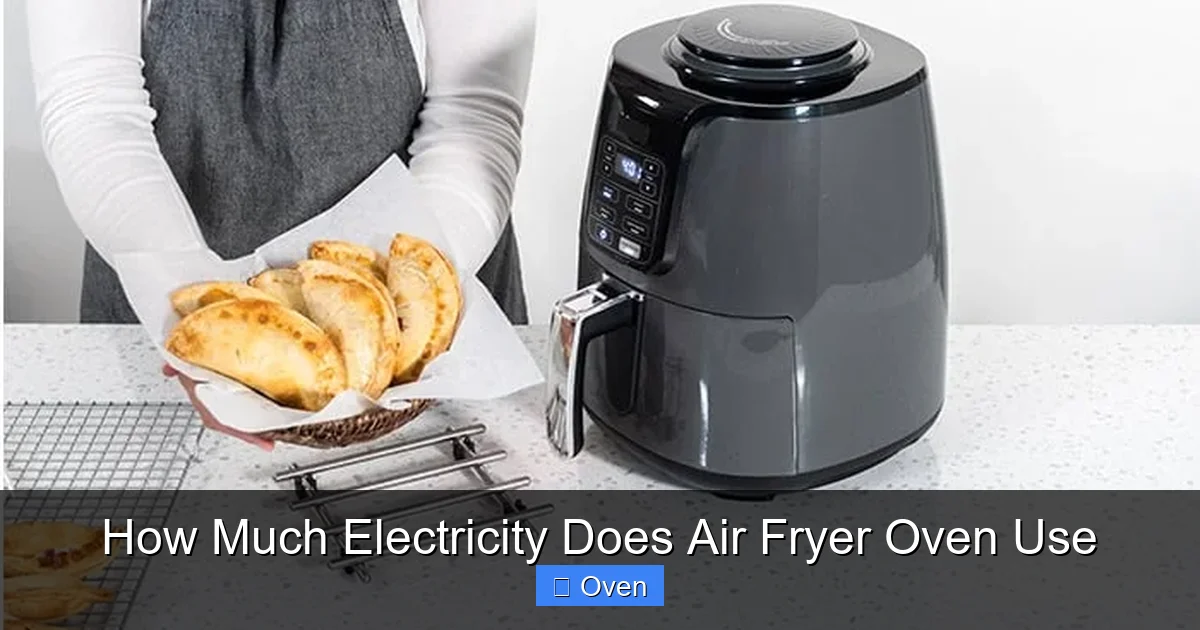
Air fryer ovens typically use 1,200-2,000 watts, consuming significantly less electricity than conventional ovens for most meals. Cooking a single meal often costs just $0.05-$0.15 in electricity, making them highly energy-efficient. You’ll save money and energy compared to traditional baking or roasting methods.
Key Takeaways
- Typical wattage range: Most air fryer ovens use 1,200-2,000 watts, with compact models at the lower end and larger units up to 2,000W
- Cost per use: Cooking a standard meal (15-20 mins) usually costs $0.05-$0.15 based on average electricity rates
- Energy savings: Uses 30-50% less electricity than conventional ovens for equivalent cooking tasks
- Key factors: Wattage, cooking time, frequency of use, and local electricity rates determine your actual costs
- Efficiency tips: Batch cooking, avoiding preheating, and using residual heat can further reduce energy use
- Long-term savings: Replacing oven use with an air fryer could save $50-$100 annually for frequent cooks
Quick Answers to Common Questions
Do air fryers use less electricity than conventional ovens?
Yes, significantly less for most common cooking tasks. Air fryers use 30-50% less energy due to faster heating, shorter cook times, and a much smaller cavity to heat compared to conventional ovens.
How much does it cost to run an air fryer for one hour?
For a typical 1,500W model running for a full hour, it would cost about $0.225 (22.5 cents) based on the average US electricity rate of $0.15/kWh. However, most cooking sessions are much shorter than an hour.
Is it cheaper to use an air fryer or microwave?
For simple reheating or heating water, a microwave is usually cheaper per minute. But for tasks requiring crisping, browning, or roasting (like fries, chicken, or veggies), the air fryer delivers vastly superior results for only a slightly higher energy cost, making it the better value for those specific tasks.
Do air fryers use a lot of electricity compared to other appliances?
No, they are among the more efficient countertop cooking appliances. They use less energy than conventional ovens, toaster ovens (for equivalent tasks), and often comparable or less than running multiple stovetop burners for roasting/baking.
Can using an air fryer save me money on my electric bill?
Absolutely! Replacing frequent conventional oven use with an air fryer can save the average household $50-$100 or more per year on their electricity bill, depending on usage patterns and local electricity rates.
📑 Table of Contents
- How Much Electricity Does Air Fryer Oven Use? Your Complete Guide
- Understanding Electricity Consumption: Watts, kWh, and Your Bill
- Typical Wattage Range for Air Fryer Ovens
- Real-World Cost Examples: How Much Does It Actually Cost?
- Air Fryer vs. Other Appliances: The Energy Efficiency Showdown
- Maximizing Efficiency: Tips to Reduce Your Air Fryer’s Electricity Use
- Conclusion: Smart Savings in Every Crisp Bite
How Much Electricity Does Air Fryer Oven Use? Your Complete Guide
Hey there! If you’re like me, you’ve probably stood in your kitchen staring at that shiny new air fryer oven wondering, “Just how much is this thing going to cost me on my electric bill?” It’s a smart question – especially when you’re trying to be more energy-conscious or just want to understand your household expenses better. Air fryers have exploded in popularity for good reason: they cook faster, crispier, and seem more efficient than traditional ovens. But what does “efficient” actually mean in terms of watts and dollars?
I get it. Electricity costs can sneak up on you. That little appliance humming away might seem harmless, but multiply its usage by days and months, and suddenly you’re looking at real money. The good news? Air fryer ovens are generally energy-sippers compared to their conventional cousins. But the exact number depends on several factors we’ll unpack together. Whether you’re considering buying your first air fryer or just want to optimize the one you already own, understanding its electricity consumption is key to making smart, cost-effective choices in your kitchen. Let’s dive into the nitty-gritty of how much electricity your air fryer oven really uses.
Understanding Electricity Consumption: Watts, kWh, and Your Bill
Before we start crunching numbers for air fryers, let’s quickly demystify how electricity use is measured and billed. It’s simpler than it sounds, and knowing this will help you calculate costs for any appliance, not just your air fryer.

Visual guide about How Much Electricity Does Air Fryer Oven Use
Image source: kitchenrank.com
The Basics: Watts and Kilowatt-Hours (kWh)
You’ve probably seen “watts” (W) listed on your appliance labels. This is the power rating – essentially, how much electrical power the device draws when running at full capacity. Think of it like the engine size of a car; a bigger engine (higher wattage) can do more work but typically uses more fuel (electricity).
However, your electricity bill isn’t based on watts alone. It’s based on kilowatt-hours (kWh). This is the unit of energy consumption. Here’s the simple math:
- 1 kilowatt (kW) = 1,000 watts (W)
- 1 kilowatt-hour (kWh) = Using 1,000 watts for 1 hour
So, if you run a 1,000-watt appliance for 1 hour, you’ve used 1 kWh. Run a 1,500-watt appliance for 1 hour? That’s 1.5 kWh. Run a 1,500-watt appliance for only 30 minutes? That’s 0.75 kWh (because 1.5 kW * 0.5 hours = 0.75 kWh).
Calculating Your Actual Cost
This is where your local electricity rate comes in. Rates vary significantly by location, time of day (some areas have time-of-use pricing), and provider. In the United States, the average residential rate is about $0.15 per kWh as of late 2023. You can find your exact rate on your monthly electricity bill – it’s usually listed clearly.
To calculate the cost of running your air fryer for a specific cooking session:
- Find the wattage (W) on the appliance label or manual.
- Convert watts to kilowatts (kW): Divide W by 1,000. (e.g., 1,500 W / 1,000 = 1.5 kW)
- Estimate the cooking time in hours (e.g., 20 minutes = 20/60 = 0.333 hours).
- Calculate kWh used: kW * Hours = kWh (e.g., 1.5 kW * 0.333 hrs = 0.5 kWh)
- Calculate cost: kWh * Your Electricity Rate = Cost (e.g., 0.5 kWh * $0.15/kWh = $0.075)
Don’t worry – we’ll do plenty of real air fryer examples shortly! This formula is your key to understanding the true cost.
Typical Wattage Range for Air Fryer Ovens
Not all air fryer ovens are created equal when it comes to power consumption. The wattage primarily depends on the unit’s size and capacity. Here’s a general breakdown:
Visual guide about How Much Electricity Does Air Fryer Oven Use
Image source: cdn.mos.cms.futurecdn.net
Compact Models (3-5 Quart Capacity)
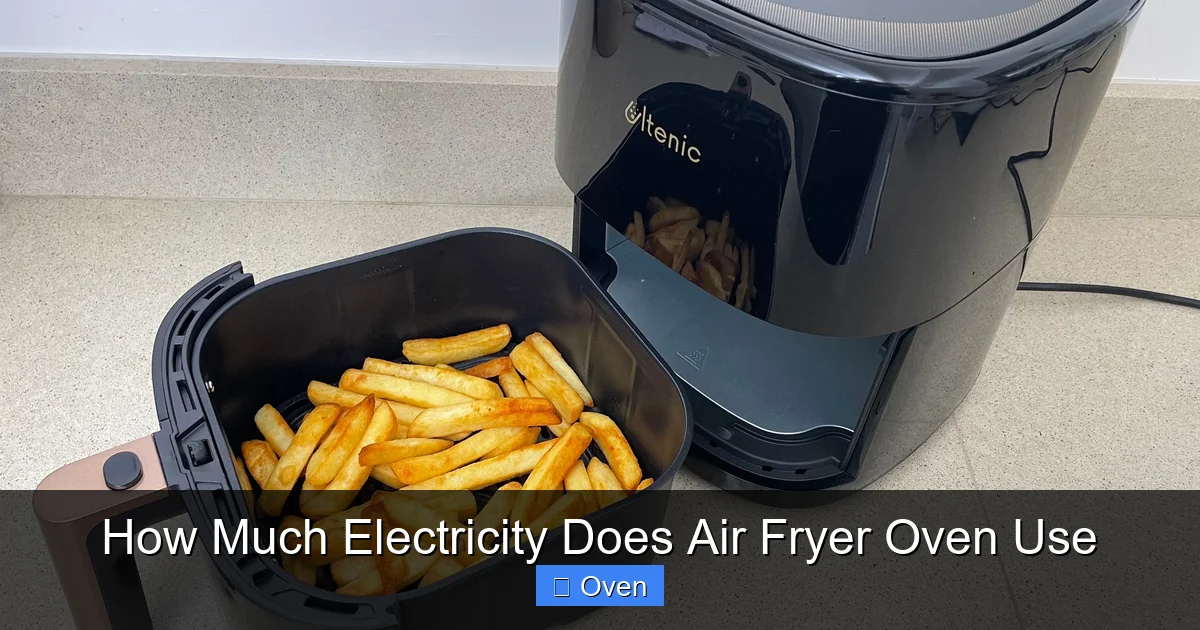
These are the most common countertop air fryers, perfect for individuals or small families. They typically operate in the 1,200 to 1,500-watt range. Why the lower wattage? Smaller heating elements and fans are needed to circulate hot air within a smaller chamber. Examples include popular models from Ninja, Cosori (smaller units), and Philips (entry-level). If you’re mostly cooking for one or two people, this is likely the category you’re in.
Mid-Size Models (6-8 Quart Capacity)
Stepping up in capacity usually means stepping up in power. These versatile units handle larger batches, whole chickens, or multiple food items simultaneously. Expect wattage in the 1,500 to 1,800-watt range. Many of the best-selling multi-function air fryer ovens (like larger Cosori, Ninja Foodi Oven, or Instant Vortex Plus) fall here. This is the sweet spot for many families.
Large Capacity & Multi-Function Ovens (9+ Quarts)
These are the powerhouses, often designed to replace a full-sized conventional oven for many tasks. They feature larger heating elements, more powerful fans, and sometimes additional functions like rotisserie or dehydration. Wattage commonly reaches 1,800 to 2,000+ watts. Models like the Ninja Foodi Smart Oven or some high-end Breville units sit in this category. While they use more power per minute, their ability to cook larger quantities efficiently can still lead to overall energy savings compared to heating a massive conventional oven.
Why Wattage Isn’t the Whole Story
It’s tempting to think the lower the wattage, the better. But remember: a higher-wattage unit might cook faster, potentially using less total energy for the same task. A 1,800W air fryer might cook your chicken in 20 minutes, while a 1,200W model takes 30 minutes. Let’s compare:
- 1,800W for 20 mins: 1.8 kW * (20/60) hrs = 0.6 kWh
- 1,200W for 30 mins: 1.2 kW * (30/60) hrs = 0.6 kWh
In this specific example, the total energy used (kWh) is the same! However, air fryers are generally so much faster than conventional ovens that even the higher-wattage models usually win on total energy consumption for equivalent cooking. The key takeaway? Focus on the total kWh used per cooking session, not just the peak wattage.
Real-World Cost Examples: How Much Does It Actually Cost?
Let’s move beyond theory and look at concrete examples. We’ll use the average US electricity rate of $0.15 per kWh for these calculations. Remember, your actual cost depends on your local rate.
Visual guide about How Much Electricity Does Air Fryer Oven Use
Image source: dadongny.com
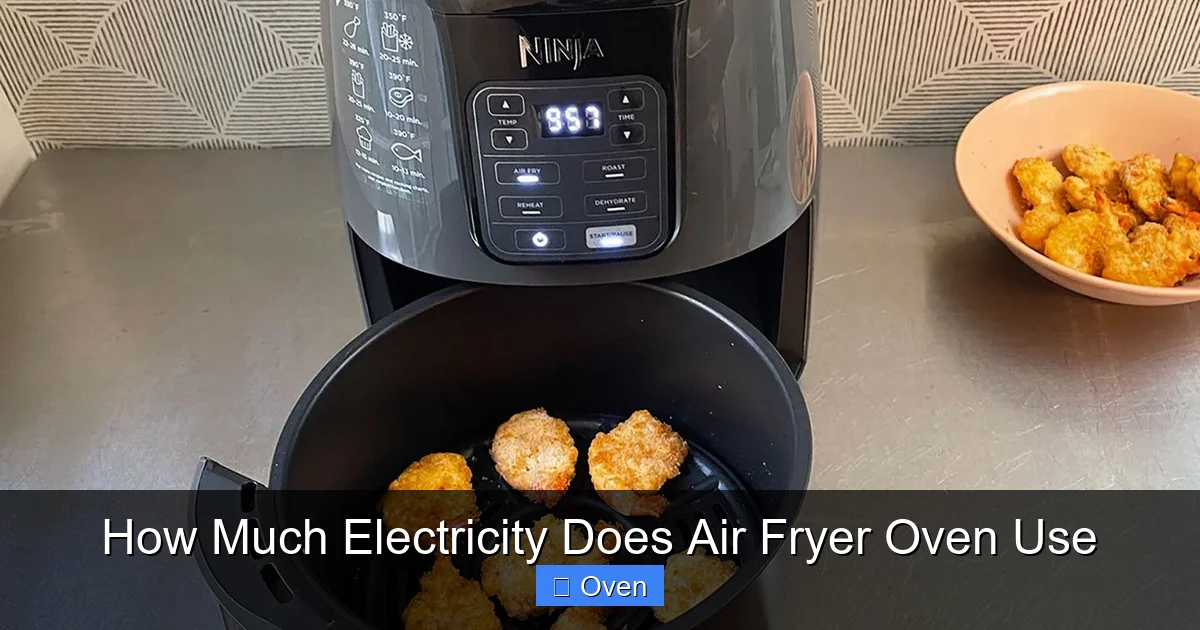
Scenario 1: Cooking Frozen French Fries (Common Use)
- Typical Setup: 1,500W air fryer oven, 15 minutes cooking time
- Calculation: 1.5 kW * (15/60) hrs = 1.5 * 0.25 = 0.375 kWh
- Cost: 0.375 kWh * $0.15/kWh = $0.056 (about 6 cents)
Compare this to a conventional oven: Preheating (10 mins @ 2,400W) + Cooking (25 mins @ 2,400W) = (2.4 * 0.167) + (2.4 * 0.417) = 0.4 + 1.0 = 1.4 kWh. Cost: 1.4 * $0.15 = $0.21 (21 cents). The air fryer saves you 15 cents *just for fries*!
Scenario 2: Roasting a Whole Chicken
- Typical Setup: 1,800W air fryer oven, 45 minutes cooking time (many models cook a 4-5lb chicken this fast)
- Calculation: 1.8 kW * (45/60) hrs = 1.8 * 0.75 = 1.35 kWh
- Cost: 1.35 kWh * $0.15/kWh = $0.20 (20 cents)
Conventional oven comparison: Preheating (15 mins @ 2,400W) + Cooking (90 mins @ 2,400W) = (2.4 * 0.25) + (2.4 * 1.5) = 0.6 + 3.6 = 4.2 kWh. Cost: 4.2 * $0.15 = $0.63 (63 cents). The air fryer saves a whopping 43 cents per chicken!
Scenario 3: Reheating Leftovers (Quick & Efficient)
- Typical Setup: 1,200W air fryer oven, 8 minutes
- Calculation: 1.2 kW * (8/60) hrs = 1.2 * 0.133 = 0.16 kWh
- Cost: 0.16 kWh * $0.15/kWh = $0.024 (less than 3 cents)
Compared to a microwave (often 1,000W for 3-4 mins = ~0.06-0.07 kWh = ~$0.009-$0.01) it’s slightly more, but the air fryer delivers superior crispy results that a microwave can’t match, making the tiny extra cost worthwhile for quality.
Monthly & Annual Cost Estimate
Let’s say you use your air fryer oven for an average of 30 minutes per day (a reasonable amount for many households – maybe 15 mins for dinner sides, 15 mins for reheating or snacks).
- Average Wattage: 1,500W (1.5 kW)
- Daily kWh: 1.5 kW * 0.5 hrs = 0.75 kWh
- Daily Cost: 0.75 kWh * $0.15 = $0.1125 (about 11 cents)
- Monthly Cost (30 days): $0.1125 * 30 = $3.38
- Annual Cost: $3.38 * 12 = $40.56
Now, compare this to using a conventional oven for the same 30 minutes of *actual cooking time* (ignoring preheat, which adds significantly more):
- Conventional Oven Wattage: ~2,400W (2.4 kW)
- Daily kWh (Cooking Only): 2.4 kW * 0.5 hrs = 1.2 kWh
- Daily Cost (Cooking Only): 1.2 kWh * $0.15 = $0.18 (18 cents)
- Monthly Cost (Cooking Only): $0.18 * 30 = $5.40
- Annual Cost (Cooking Only): $5.40 * 12 = $64.80
The air fryer saves you roughly $24 per year JUST on the cooking time. Factor in the massive preheating energy of the conventional oven (which we didn’t include here, as air fryers often skip preheat), and the savings jump to $50-$100+ annually for frequent users. That’s a significant chunk of change!
Air Fryer vs. Other Appliances: The Energy Efficiency Showdown
Understanding where the air fryer oven stands compared to other common kitchen appliances puts its efficiency into perspective. Let’s break it down:
Air Fryer Oven vs. Conventional Oven
This is the big one, and the air fryer wins hands-down for most everyday cooking tasks:
- Heating Time: Air fryers heat up in 2-5 minutes (often no preheat needed). Conventional ovens take 10-20+ minutes just to preheat.
- Cooking Time: Air fryers cook 20-40% faster due to concentrated, circulating hot air in a small space.
- Energy Use: As shown in our examples, air fryers typically use 30-50% less energy for equivalent cooking (roasting, baking, reheating). The smaller cavity means less air to heat.
- Best For: Air fryer wins for most weeknight dinners, sides, reheating, and smaller roasts. Conventional oven is still better for very large items (whole turkeys), delicate baking (soufflés), or when you need precise, even low-heat.
Air Fryer Oven vs. Microwave
Microwaves are incredibly efficient at heating water (great for soups, veggies, reheating liquids) but terrible at browning or crisping:
- Energy Use: Microwaves are generally more efficient *per minute* for simple heating tasks (e.g., reheating coffee). A typical 1,000W microwave for 2 mins uses ~0.033 kWh.
- The Catch: If you want crispy fries, roasted veggies, or a reheated pizza with a crunchy crust, the microwave fails. The air fryer uses slightly more energy for these tasks (e.g., 0.16 kWh for 8 mins vs microwave’s 0.033 kWh for 2 mins reheating), but delivers vastly superior results. It’s about matching the tool to the task.
Air Fryer Oven vs. Toaster Oven
Toaster ovens are also energy-efficient alternatives to full ovens, but air fryers usually have the edge:
- Similarities: Both are small countertop ovens, faster to heat than conventional ovens.
- Differences: Air fryers use a powerful fan for rapid, even circulation, leading to faster cooking and better crisping. Toaster ovens rely mainly on radiant heat from top/bottom elements.
- Energy Use: Wattage is often similar (1,200-1,800W). However, the air fryer’s speed usually means less total cooking time, resulting in slightly lower total kWh for comparable tasks like toasting, baking small items, or roasting. For simple toasting, a basic toaster (800-1,500W) is still the most efficient.
Air Fryer Oven vs. Stovetop (Electric Coil or Induction)
This is more task-dependent:
- Boiling Water: An electric kettle (1,500-3,000W) is vastly more efficient than a stovetop pot. Induction cooktops are very efficient at transferring heat to the pan.
- Searing/Stir-frying: A stovetop (especially induction) is generally more efficient for quick, high-heat tasks in a pan.
- Roasting/Baking: The air fryer is almost always more efficient than using multiple stovetop burners or a conventional oven for these tasks.
The Verdict: The air fryer oven shines brightest when replacing conventional oven use for roasting, baking (small batches), reheating, and achieving crispy results. It’s not a replacement for *all* appliances, but it’s a highly efficient workhorse for a huge range of common cooking needs.
Maximizing Efficiency: Tips to Reduce Your Air Fryer’s Electricity Use
Even though air fryers are inherently efficient, a few smart habits can squeeze out even more savings and reduce your energy footprint:
Cook in Batches (Wisely!)
This is the golden rule. Never run your air fryer for just one or two small items. Cook enough for your meal plus leftovers, or cook multiple components of a meal at once (e.g., chicken and veggies together if compatible). However, avoid overloading the basket – food needs space for air circulation, or cooking time increases and results suffer. Find the sweet spot for your model’s capacity.
Skip the Preheat (Most of the Time)
Unlike conventional ovens, many air fryer recipes don’t require preheating. The powerful fan heats the small chamber incredibly quickly. Put your food in cold, set the time/temp, and go. You’ll save those 2-5 minutes of energy. Only preheat if a specific recipe explicitly calls for it (e.g., some delicate pastries).
Leverage Residual Heat
Air fryers retain heat well in their small chamber. Turn off the air fryer 2-5 minutes before the timer ends for foods that continue cooking with residual heat (like thicker cuts of meat or dense veggies). The internal temperature will keep rising, finishing the cook without using extra electricity. Just keep an eye on it!
Choose the Right Size & Settings
Use the smallest basket or tray setting that fits your food. Cooking a single portion in a large 8-quart oven uses more energy than using a compact 4-quart model. Also, use the lowest effective temperature. Many foods cook perfectly well at 375°F instead of 400°F, potentially shaving a few minutes off cook time. Avoid unnecessarily high temps.
Keep it Clean for Optimal Performance
A dirty air fryer with grease buildup on the heating element or fan can become less efficient over time. The element has to work harder to heat up, and airflow might be restricted, potentially increasing cook time. Regularly clean the basket, tray, and interior according to the manufacturer’s instructions (usually with warm soapy water). This ensures it operates at peak efficiency.
Plan Ahead & Combine Tasks
Think about your cooking sequence. Can you cook your main protein first, then while it rests, quickly cook your veggies? Or cook components that need different temps sequentially without fully cooling the unit? Minimize the number of times you start and stop the air fryer in a single cooking session, as the initial heat-up draws a bit more power.
Conclusion: Smart Savings in Every Crisp Bite
So, how much electricity does an air fryer oven use? As we’ve discovered, it’s generally a very energy-conscious choice for your kitchen. Most models operate between 1,200 and 2,000 watts, translating to a cost of just 5 to 15 cents per typical meal based on average electricity rates. When you compare that to the 20-60+ cents (or more!) it often costs to use a conventional oven for the same task, the savings become clear and compelling.
The real magic lies in the combination of factors: the smaller cooking chamber heats up incredibly fast (often eliminating preheat), the powerful fan ensures efficient and rapid cooking, and the concentrated heat delivers deliciously crispy results in a fraction of the time. This efficiency isn’t just good for your wallet – it’s good for the planet too, reducing your household’s overall energy consumption. By adopting simple habits like batch cooking, skipping unnecessary preheating, and using residual heat, you can maximize these savings even further.
Choosing an air fryer oven isn’t just about getting perfectly crispy fries or a juicy chicken; it’s a smart investment in energy efficiency and cost savings for your everyday cooking. It empowers you to enjoy your favorite foods more often without the guilt of a soaring electric bill. So go ahead, fire up that air fryer with confidence – you’re making a choice that’s kinder to both your taste buds and your budget, one energy-efficient, delicious meal at a time.
Frequently Asked Questions
What is the average wattage of a home air fryer oven?
Most home air fryer ovens range from 1,200 watts for compact 3-5 quart models up to 2,000+ watts for large 9+ quart multi-function units. Mid-size 6-8 quart models typically fall between 1,500-1,800 watts. Always check the label on the specific model you own or are considering.
How do I calculate the exact electricity cost for my air fryer?
Find your air fryer’s wattage (W) on the label/manual. Convert to kilowatts (kW) by dividing by 1,000. Multiply kW by your cooking time in hours to get kWh used. Finally, multiply kWh by your electricity rate (found on your bill, average US is ~$0.15/kWh). Example: 1,500W (1.5kW) for 0.33 hours (20 mins) = 0.5 kWh. Cost = 0.5 * $0.15 = $0.075.
Does preheating an air fryer waste electricity?
Generally, yes. Most air fryer recipes don’t require preheating because the small chamber heats up extremely quickly (2-5 minutes). Skipping preheat saves those few minutes of energy. Only preheat if a specific recipe explicitly instructs you to do so.
Are larger air fryer ovens less energy efficient?
Not necessarily. While larger models have higher peak wattage (up to 2,000W+), they can cook bigger batches faster. The key is total kWh used per meal. A large air fryer cooking a whole chicken efficiently might use less total energy than a small one cooking multiple smaller batches or a conventional oven cooking the same chicken. Match the appliance size to your typical batch size.
How does air fryer electricity use compare to a gas oven?
Gas ovens have lower operating costs per hour than electric ovens in many areas, but they are generally less efficient at converting energy to heat and take longer to preheat/cook. Air fryers (electric) are still typically more energy-efficient than *either* gas or electric conventional ovens for most everyday tasks due to their speed and small size, leading to lower total energy consumption per meal.
Can I run my air fryer on a generator or solar power?
Yes, but check the wattage requirements. A typical 1,500W air fryer needs a generator or inverter system rated for at least 1,800-2,000 starting watts (surge) and 1,500 running watts. Always verify your specific model’s wattage and your power source’s capacity before connecting. Solar setups need sufficient battery storage and inverter capacity.