
Air fryers typically use 20-30% less energy than conventional ovens for small-to-medium meals, slashing both cooking time and electricity bills. However, this advantage depends heavily on what you’re cooking and batch size—large roasts or baked goods still favor the oven. Smart pairing of both appliances maximizes savings while keeping your kitchen versatile.
Key Takeaways
- Wattage Wins: Most air fryers (1,500W) use less power than standard ovens (2,000-5,000W), but ovens heat larger spaces inefficiently for small meals.
- Time is Energy: Air fryers cook 20-40% faster for items like fries or chicken, directly reducing kWh consumption per meal.
- Batch Size Matters: Air fryers shine for 1-4 servings; ovens become more efficient for large roasts, casseroles, or baking multiple trays.
- Real Savings: Cooking a meal for two in an air fryer vs oven can save $0.10-$0.30 per use—adding up to $50+ yearly with regular use.
- Preheat Pitfall: Skipping oven preheating (common with air fryers) saves significant energy—up to 15% per cooking session.
- Convection Ovens Bridge the Gap: Modern convection ovens narrow the energy gap but still lag behind dedicated air fryers for speed and small batches.
- Smart Strategy: Use your air fryer for weeknight dinners and snacks; reserve the oven for large gatherings or recipes requiring precise baking.
Quick Answers to Common Questions
Can I completely replace my oven with an air fryer?
Not for all tasks. Air fryers excel at small-batch roasting, reheating, and crisping but can’t handle large roasts, multi-rack baking, or delicate pastries. Keep your oven for big gatherings and baking—use the air fryer for 70% of everyday meals.
Do air fryers use less energy than toaster ovens?
Generally yes. Toaster ovens (1,200-1,800W) are similar in wattage but heat a larger cavity than air fryers, often taking longer to cook small batches. Air fryers’ focused airflow usually makes them 15-25% more efficient for fries, wings, or single servings.
Is it worth buying an air fryer just for energy savings?
Absolutely—if you cook small meals regularly. The $0.10-$0.30 per-use savings adds up fast, and most units pay for themselves in 1-2 years via reduced electricity bills. Plus, you’ll save time and enjoy crispier results!
Why does my oven use more energy even with convection?
Convection ovens are more efficient than conventional ones but still heat a massive space. A full-size convection oven (2,500-3,500W) dwarfs an air fryer’s 1,500W draw. For small batches, the air fryer’s compact size and faster cook times win—even with convection.
Can I save energy by using my air fryer instead of the microwave?
For reheating, microwaves are usually more efficient (0.7-1.2 kWh vs. air fryer’s 0.3-0.5 kWh for similar tasks). But for crisping or browning—like reviving pizza—the air fryer’s superior results may justify the slight energy trade-off.
📑 Table of Contents
- Why Your Kitchen Appliances Are Secretly Draining Your Wallet (And How to Stop It)
- Breaking Down the Power Players: Wattage, kWh, and What Actually Matters
- Cooking Time: The Silent Energy Killer (or Saver)
- The Real Math: Calculating Your Actual Energy Savings
- Beyond the Numbers: Practical Tips to Maximize Energy Savings
- The Bigger Picture: Environmental Impact and Long-Term Value
- Conclusion: Your Energy-Smart Kitchen Strategy
Why Your Kitchen Appliances Are Secretly Draining Your Wallet (And How to Stop It)
Let’s talk about that moment when your electricity bill arrives. You stare at the number, wondering, “Did my oven really cost THAT much?” If you’re like most home cooks, you’ve probably felt that sting. Ovens are energy hogs—especially when you’re just reheating leftovers or cooking for two. Enter the air fryer: the sleek, countertop hero promising crispy food with less oil. But here’s the real question buzzing in eco-conscious kitchens: how much energy does an air fryer use compared to an oven? Is it truly the energy-saving sidekick we’ve been led to believe?
We’ve all been there. You pop frozen fries into the oven, wait 20 minutes for it to preheat, then bake for another 25. Meanwhile, your air fryer whirs to life in 3 minutes and finishes in 15. It feels faster—but does it actually use less electricity? The answer isn’t just “yes” or “no.” It’s about understanding the physics of heat, the quirks of your appliances, and how your cooking habits tip the scales. In this deep dive, we’ll crack open the numbers, bust myths, and give you actionable tips to slash your kitchen’s energy footprint. Whether you’re a meal-prep pro or a weekend baker, this comparison will change how you cook—and save you real money.
Breaking Down the Power Players: Wattage, kWh, and What Actually Matters
Before we compare air fryers and ovens, let’s decode the jargon. You’ve probably seen “watts” on appliance labels, but what does it mean for your energy bill? Watts measure instantaneous power draw—like the horsepower of your kitchen gadgets. But your electric company charges you for kilowatt-hours (kWh), which is energy used over time. Think of it like this: watts are speed (how fast you drive), kWh is distance (how far you travel). Both matter, but kWh is what hits your wallet.
Visual guide about How Much Energy Does an Air Fryer Use Compared to an Oven 2
Image source: askanydifference.com
Typical Wattage Ranges: Air Fryer vs. Oven
Most standard air fryers operate between 1,200 and 1,800 watts. Why such a range? Smaller models (3-4 quart) hover around 1,200W, while larger 6-quart units max out near 1,800W. They’re designed to heat a compact chamber quickly using a powerful fan and heating element. Now, contrast that with conventional ovens. A typical home oven ranges from 2,000 to 5,000 watts—and that’s just for the bake function! When you fire up the broiler or convection fan, it can spike even higher. The kicker? Ovens heat a massive cavity (often 30+ cubic feet), while air fryers heat a space smaller than a shoebox. That size difference is the first clue to energy efficiency.
Why Wattage Alone Lies to You
Here’s where things get tricky. A 1,500W air fryer seems gentler than a 3,000W oven, but if the oven cooks your food in half the time, it might use less total energy. That’s why we must calculate kWh: (Watts ÷ 1,000) × Hours Used. For example:
- Air Fryer: 1,500W × 0.25 hours (15 mins) = 0.375 kWh
- Oven: 3,000W × 0.5 hours (30 mins, including preheat) = 1.5 kWh
In this scenario, the air fryer uses 75% less energy for the same meal. But real life isn’t always this clear-cut. Ovens often cycle on/off to maintain temperature, while air fryers run at full blast. Preheating adds hidden energy costs. And if you’re cooking a giant turkey? The oven wins by default. Let’s dig into the variables that tip the scales.
Cooking Time: The Silent Energy Killer (or Saver)
Time isn’t just money—it’s electricity. The longer your appliance runs, the more kWh it guzzles. This is where air fryers often pull ahead, thanks to their compact size and turbocharged airflow. But it’s not universal. Let’s compare real-world scenarios.

Visual guide about How Much Energy Does an Air Fryer Use Compared to an Oven 2
Image source: afresherhome.com
Speed Demons: Air Fryers for Small Batches
Imagine cooking four chicken wings. In a conventional oven:
- Preheat: 12-15 minutes (oven drawing 2,500W)
- Cook time: 25-30 minutes (oven cycling between 2,000-2,500W)
- Total energy: ~1.2 kWh
Now, the same wings in a 1,500W air fryer:
- Preheat: 3 minutes (often skipped entirely)
- Cook time: 12-15 minutes
- Total energy: ~0.35 kWh
That’s a 70% reduction in energy use for identical results. Why? Air fryers blast hot air directly onto food via a high-speed fan, eliminating the need to heat a large air volume. Ovens, meanwhile, must warm the entire cavity—and that takes serious time and power. For frozen fries, salmon fillets, or roasted veggies for 2-4 people, air fryers consistently win on speed and efficiency.
When Ovens Outpace Air Fryers
But air fryers aren’t magic. Try cooking a 12-pound turkey or a triple-layer cake. Suddenly, the oven’s spacious interior becomes an asset. Air fryers struggle with large, dense items because:
- Overcrowding blocks airflow, leading to uneven cooking and longer times.
- Many models can’t accommodate roasting pans or baking sheets.
- High-heat roasting (like for crispy skin) may exceed the air fryer’s max temperature (usually 400°F vs. oven’s 500°F+).
In these cases, the oven might cook faster per pound of food. Example: A whole chicken (4 lbs) in a convection oven takes ~1 hour at 3,000W (1.5 kWh). The same chicken in a large air fryer? 50 minutes at 1,800W (1.5 kWh)—but you’d likely need to spatchcock it, adding prep time. For massive batches, ovens often deliver better energy-per-serving efficiency.
The Real Math: Calculating Your Actual Energy Savings
Enough theory—let’s talk dollars. How much does switching to an air fryer actually save? It depends on your local electricity rate (U.S. average: $0.16/kWh), but we’ll use realistic examples.

Visual guide about How Much Energy Does an Air Fryer Use Compared to an Oven 2
Image source: afresherhome.com
Case Study: Weeknight Dinner for Two
Scenario: Roasting 2 chicken breasts and 1 cup of broccoli.
- Oven: Preheat 15 mins (2,500W) + cook 25 mins (2,000W avg) = 1.46 kWh → $0.23
- Air Fryer: No preheat + cook 15 mins (1,500W) = 0.375 kWh → $0.06
Savings per meal: $0.17. Cook this 3x/week? That’s $26.52/year just on dinners. Add snacks (fries, mozzarella sticks) and leftovers, and you’re looking at $40-$50 annually.
The Preheat Factor: A Hidden Energy Drain
Here’s a shocker: Preheating your oven can account for 10-15% of total energy use per cooking session. Why? That initial blast of heat to bring 30+ cubic feet of air to temperature is massive. Air fryers minimize this—many don’t require preheating, and their tiny chamber heats almost instantly. Even convection ovens (which use a fan) take 8-10 minutes to preheat vs. 3-5 for air fryers. If you’re the type who preheats “just in case” for 20 minutes, you’re burning cash. Pro tip: Skip preheating for air fryers and most oven recipes (except breads or delicate pastries).
Convection Ovens: The Middle Ground
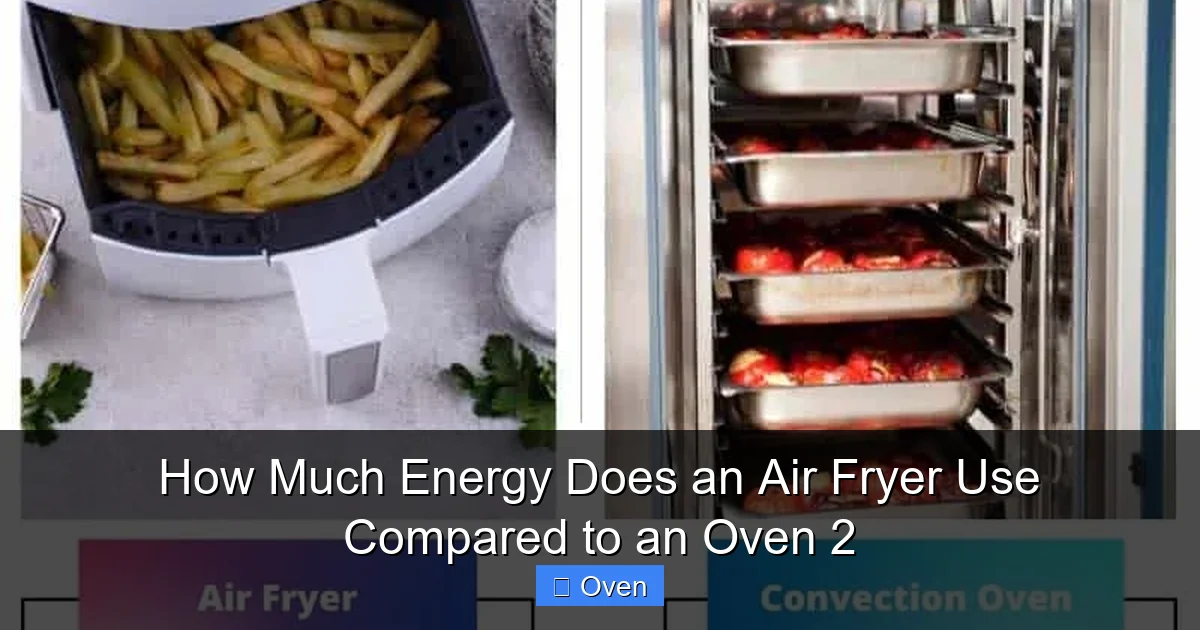
Modern convection ovens (with a fan) bridge the efficiency gap. They cook 25% faster than conventional ovens by circulating hot air—similar to air fryers. For a batch of cookies:
- Conventional oven: 15 mins preheat + 12 mins bake = 0.85 kWh
- Convection oven: 10 mins preheat + 9 mins bake = 0.65 kWh
- Air fryer: 3 mins preheat + 8 mins bake = 0.22 kWh
Convection ovens save 24% vs. conventional but still use 3x more energy than the air fryer for this small batch. They’re a great upgrade if you’re oven shopping, but air fryers remain the efficiency champs for portions under 4 servings.
Beyond the Numbers: Practical Tips to Maximize Energy Savings
Knowing the stats is great, but how do you apply this? It’s not about ditching your oven—it’s about strategic pairing. Here’s how to make both appliances work smarter.
When to Reach for the Air Fryer (The Energy Sweet Spot)
Air fryers dominate these scenarios:
- Small portions: 1-4 servings of proteins, veggies, or frozen apps.
- Quick reheats: Leftover pizza? 3 minutes in the air fryer beats 15 in the oven.
- High-heat crisping: Wings, salmon skin, or roasted chickpeas—tasks where ovens waste energy preheating.
- Energy-intensive oven tasks: Baking a single potato? Air fryer wins. Roasting a tray of asparagus? Air fryer wins.
Pro move: Batch-cook components. Air fry chicken while oven roasts a big tray of root veggies for the week. Use residual oven heat to warm plates or dry herbs.
When Your Oven Deserves the Spotlight
Don’t relegate your oven to dust—it excels here:
- Large roasts: Turkeys, hams, or whole chickens (over 5 lbs).
- Baking: Cakes, breads, casseroles—recipes needing precise, even heat.
- Multi-rack cooking: Need to bake cookies on two sheets simultaneously? Oven’s capacity shines.
- Low-and-slow tasks: Braising, proofing dough, or dehydrating.
Bonus tip: Use the oven’s “warm” setting (170°F) to keep food hot while finishing other dishes—it uses less power than reheating.
Smart Habits That Multiply Savings
Even with the right appliance, these habits cut waste:
- Match pot to burner: Oversized pots on small burners waste 40% more energy. Same logic applies to oven racks—don’t block airflow!
- Keep it clean: Grease buildup insulates heating elements, forcing appliances to work harder. Wipe air fryer baskets and oven cavities monthly.
- Use residual heat: Turn off the oven 5-10 minutes early—it’ll finish cooking with stored heat. Air fryers cool fast, so this works best for ovens.
- Skip the light: That little oven light? It draws 10-20W constantly. Peek through the window instead.
Remember: Energy savings compound. Saving $0.10 per meal adds up fast when you cook daily.
The Bigger Picture: Environmental Impact and Long-Term Value
Your wallet isn’t the only thing affected by appliance choices. Energy consumption ties directly to carbon emissions—especially if your grid relies on fossil fuels. Let’s put numbers to it.
Carbon Footprint Comparison
Assuming the U.S. average grid emissions (0.855 lbs CO2 per kWh):
- Cooking a meal in an oven: 1.5 kWh → 1.28 lbs CO2
- Same meal in air fryer: 0.4 kWh → 0.34 lbs CO2
That’s a 73% reduction in emissions per meal. If a family of four switches 5 oven meals/week to air frying? That’s 240 lbs of CO2 saved annually—equivalent to planting 3 trees. While individual actions seem small, collective shifts matter. As air fryer adoption grows (projected to hit 30% of U.S. households by 2025), the grid impact could be significant.
Beyond Energy: Total Cost of Ownership
Air fryers aren’t just energy-sippers—they’re budget-friendly long-term:
- Upfront cost: $60-$150 vs. $500+ for a new oven. Payback period? Often under 2 years via energy savings.
- Lifespan: Quality air fryers last 5-7 years (similar to ovens). No hidden costs like oven self-cleaning cycles (which can use 5-8 kWh per run!).
- Versatility: Replaces toaster ovens, deep fryers, and dehydrators—consolidating energy drains.
One caveat: Cheap air fryers (<$50) may have shorter lifespans or uneven heating. Invest in reputable brands (Ninja, Cosori, Instant Vortex) for consistent efficiency.
Conclusion: Your Energy-Smart Kitchen Strategy
So, how much energy does an air fryer use compared to an oven? For the majority of everyday cooking—think weeknight dinners, snacks, and small-batch roasting—air fryers use 20-30% less energy, primarily by slashing cooking time and avoiding the oven’s massive preheat penalty. But this isn’t a knockout victory. Ovens remain indispensable for large gatherings, baking, and recipes demanding precise, gentle heat. The real win? Strategic synergy.
Imagine your kitchen as an energy ecosystem. Your air fryer handles the quick, high-heat tasks where speed equals savings. Your oven tackles the big jobs where its capacity shines. By matching the tool to the task—and adopting smart habits like skipping preheats and using residual heat—you’ll cut energy use without sacrificing versatility. Over a year, that could mean $50+ back in your pocket and a lighter footprint on the planet. It’s not about choosing one appliance over the other; it’s about letting each do what it does best. So next time you’re tempted to fire up the oven for a single serving of roasted veggies, remember: that little countertop hero might just be your most efficient kitchen ally. Now go forth and cook smarter—not harder.
Frequently Asked Questions
Do air fryers really save electricity compared to ovens?
Yes, for small-to-medium meals. Air fryers use 20-30% less energy primarily because they cook faster and avoid the oven’s lengthy preheat phase. For a typical dinner for two, you might save $0.15-$0.25 per use.
How much does it cost to run an air fryer for 30 minutes?
At 1,500W and $0.16/kWh, 30 minutes costs about $0.12. Compare that to a 3,000W oven running for 45 minutes (including preheat), which costs roughly $0.36—three times more for similar results.
Is preheating an air fryer necessary for energy savings?
Most air fryer recipes don’t require preheating, and skipping it saves 5-10% energy per session. The compact chamber heats almost instantly, so you can often go straight from cold to cooking—unlike ovens, which need 10-15 minutes to warm up.
Are convection ovens as energy-efficient as air fryers?
Convection ovens are 20-25% more efficient than conventional ovens but still use 2-3x more energy than air fryers for small batches. They’re a great middle ground if you rarely cook for 1-4 people, but air fryers remain the efficiency leaders for portion sizes under 4 servings.
Can using an air fryer reduce my carbon footprint?
Definitely. By using 20-30% less electricity per meal, air fryers lower CO2 emissions—especially in regions with coal-heavy grids. Cooking 5 meals/week in an air fryer instead of an oven could save over 200 lbs of CO2 annually.
What’s the most energy-wasting oven habit to avoid?
Preheating unnecessarily is the biggest culprit. Many recipes don’t require full preheating, and ovens lose heat every time you open the door. For roasting or baking, skip preheating or reduce it by 5-10 minutes—you’ll save 10-15% energy per use without affecting results.