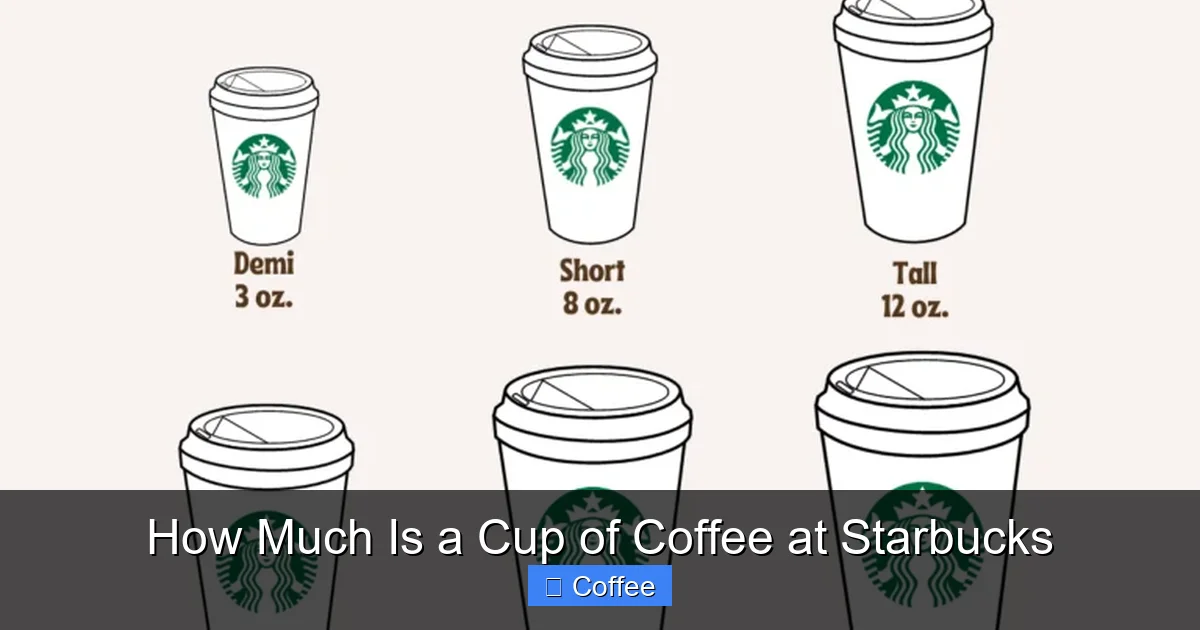
Starbucks coffee prices range from $2.25 for basic brewed coffee to over $6 for customized lattes, heavily influenced by location, size, and add-ons. While often pricier than competitors, understanding the pricing structure helps you make smarter choices without sacrificing your daily ritual. Knowing when and how to order can save you significant money over time.
Key Takeaways
- Base prices start low: A simple Tall (12oz) brewed coffee costs $2.25-$2.75, making it Starbucks’ most affordable option.
- Size significantly impacts cost: Upgrading from Tall to Venti (20oz) adds $0.50-$1.00 for most drinks, but iced coffee sees larger jumps.
- Customizations add up fast: Each syrup shot ($0.80), alternative milk ($0.80), or extra espresso shot ($0.80-$1.00) quickly increases your total.
- Location is a major factor: Urban stores (especially NYC, SF) charge 10-20% more than suburban or rural locations due to higher operating costs.
- Seasonal & specialty drinks are premium: Pumpkin Spice Lattes or holiday beverages often cost $0.50-$1.00 more than standard lattes.
- Mobile ordering saves money: The Starbucks app frequently offers exclusive discounts and free birthday rewards, reducing effective cost.
- Refills are a hidden perk: Hot brewed coffee refills cost just $0.50-$1.00 in most stores, ideal for slow sippers.
Quick Answers to Common Questions
What’s the absolute cheapest coffee at Starbucks?
The cheapest option is a Tall (12oz) hot brewed coffee, typically priced between $2.25 and $2.75, depending on location. A single shot of espresso is also very affordable at $1.75-$2.25, though it’s a small serving.
Why is Starbucks coffee more expensive than Dunkin’ or McDonald’s?
Starbucks commands a premium due to its focus on higher-quality (though not necessarily “premium”) beans, a consistent “third place” experience with seating and Wi-Fi, extensive customization options, a vast store network with high urban rents, and significant investments in ethical sourcing and technology like their app. Dunkin’ and McDonald’s prioritize speed and value over ambiance.
Does the Starbucks app really save you money?
Yes, significantly. The free Starbucks Rewards program (accessed via the app) earns you stars towards free drinks/food with every purchase, offers exclusive discounts, provides birthday rewards, and enables mobile ordering which often has app-only deals. It’s the single best tool for reducing your effective cost per visit.
Are refills really cheap at Starbucks?
Hot brewed coffee refills are very affordable, usually costing $0.50 to $1.00 in most stores. This makes it economical to get a large Venti brewed coffee and refill it later if you’re working in-store. Refills generally do *not* apply to espresso-based drinks like lattes.
Is oat milk worth the extra $0.80-$1.00?
That’s subjective! Oat milk froths well, has a neutral sweetness, and is popular for dietary/environmental reasons. If you prefer its taste or need it for dietary needs, the cost is justified for you. If you’re indifferent, sticking with standard 2% milk saves nearly $1 per drink, which adds up fast for daily customers.
📑 Table of Contents
- How Much Is a Cup of Coffee at Starbucks? Your Complete Pricing Guide
- The Foundation: Base Prices for Core Coffee Drinks
- How Size Truly Affects Your Starbucks Bill
- The Customization Cost Breakdown: Where Your Money Really Goes
- Location, Location, Location: The Starbucks Price Multiplier
- Smart Strategies to Save Money on Your Starbucks Habit
- Beyond the Price Tag: Understanding the Starbucks Value Proposition
- Conclusion: Making Starbucks Work for Your Wallet and Your Routine
How Much Is a Cup of Coffee at Starbucks? Your Complete Pricing Guide
Let’s be honest: that morning Starbucks run is non-negotiable for millions of us. But have you ever stood in line, watched the total climb with each customization, and wondered, “Wait, how much is a cup of coffee at Starbucks *really*?” You’re not alone. Starbucks pricing feels like a moving target – influenced by where you are, what you order, and even the time of year. It’s not just about the coffee; it’s about the experience, the convenience, and that little dopamine hit from the green siren logo. But understanding the actual numbers empowers you to enjoy your ritual without budget panic.
Starbucks isn’t shy about its premium positioning. They’ve built an empire on consistency, ambiance, and customization, which naturally comes with a price tag higher than your local diner or gas station brew. Yet, within that premium, there’s surprising variation. A simple black coffee in a small town might cost half as much as a complex caramel macchiato in downtown Manhattan. The key isn’t just knowing the *average* price, but understanding *why* prices shift and how you can navigate the menu to get the best value for *your* coffee needs. Whether you’re a daily drip coffee drinker or a seasonal latte lover, this guide breaks down the real costs.
The Foundation: Base Prices for Core Coffee Drinks
Visual guide about How Much Is a Cup of Coffee at Starbucks
Image source: caffeinedude.com
Before we dive into the world of syrups and alternative milks, let’s establish the baseline. Starbucks offers several fundamental coffee options, each with its own starting price point. These are the anchors upon which all customizations build.
Brewed Coffee: The Budget-Friendly Staple
This is Starbucks’ most affordable entry point. A standard hot brewed coffee (using their Pike Place Roast or similar house blend) is surprisingly accessible. Expect to pay:
* **Tall (12oz): $2.25 – $2.75**
* **Grande (16oz): $2.75 – $3.25**
* **Venti (20oz): $3.25 – $3.75**
Prices lean towards the lower end in suburban or rural stores and the higher end in major metropolitan areas. The beauty here is simplicity: hot water, coffee grounds, and a paper cup. No frills, just reliable caffeine. This is where Starbucks competes most directly with fast-food chains and convenience stores, though it’s still generally pricier than a $1 McDonald’s coffee.
Iced Coffee: Cool Refreshment, Slightly Higher Cost
Iced coffee commands a small premium over its hot counterpart, primarily due to the extra steps (chilling, potentially different brewing methods like cold brew). Base prices typically run:
* **Tall (12oz): $2.75 – $3.25**
* **Grande (16oz): $3.25 – $3.75**
* **Venti (20oz): $3.75 – $4.25**
Notice the jump? A Venti iced coffee often costs nearly double a Tall hot brewed coffee. The reason? More coffee grounds are needed to achieve the same strength when diluted by ice, and the preparation is slightly more labor-intensive. Cold Brew, a slower-steeped, smoother alternative, usually starts around $3.50 for a Tall and climbs to $4.75+ for a Venti.
Espresso: The Concentrated Shot
The purest form of Starbucks’ coffee engine. A single shot of espresso is the building block for most specialty drinks but can be ordered solo:
* **Single Shot (1oz): $1.75 – $2.25**
* **Double Shot (2oz/Doppio): $2.25 – $2.75**
While not a “cup” in the traditional sense, it’s the essential ingredient. Ordering just espresso is the absolute cheapest way to get a caffeine hit at Starbucks, though it’s a very small serving. Most people build on this foundation.
How Size Truly Affects Your Starbucks Bill
Visual guide about How Much Is a Cup of Coffee at Starbucks
Image source: caffeinedude.com
Starbucks sizes – Tall, Grande, Venti – are iconic, but their price increments aren’t always linear. Understanding this helps avoid surprises, especially with iced drinks.
The Hot Coffee Size Sweet Spot
For hot brewed coffee and most hot espresso drinks (like lattes or cappuccinos), upgrading sizes is relatively economical:
* **Tall to Grande:** Usually adds $0.50.
* **Grande to Venti:** Usually adds another $0.50.
So, a Tall hot latte might be $4.00, Grande $4.50, Venti $5.00. The cost per ounce decreases as you go larger, making the Venti often the best value *if* you actually drink that much. For example, a $5.00 Venti hot latte gives you 20oz, or $0.25 per ounce, while a $4.00 Tall gives 12oz, or $0.33 per ounce.
The Iced Coffee Size Trap
This is where things get pricier. Iced drinks have a significant amount of ice, meaning less actual liquid coffee per cup compared to hot versions. To compensate for dilution and the extra coffee needed:
* **Tall to Grande:** Often adds $0.75-$1.00.
* **Grande to Venti:** Often adds another $0.75-$1.00.
A Tall iced latte might start at $4.50, but a Venti can easily hit $6.00 or more. The cost per *drinkable* ounce is much higher than hot coffee. You’re paying significantly more for the same perceived “size” due to the ice volume. If you prefer iced, consider if the Grande truly satisfies you before automatically ordering Venti.
Why Venti Hot is Cheaper Than Venti Iced (Usually)
This often confuses customers. A Venti *hot* latte is typically cheaper than a Venti *iced* latte of the same base drink. The reason is simple: the hot version contains 20oz of liquid (coffee + milk). The iced version contains 20oz of *total volume*, but 30-50% of that is ice, meaning only 10-14oz of actual liquid. Starbucks charges more for iced to account for the extra coffee grounds needed to maintain flavor strength after melting ice dilutes it. Always compare the *liquid* volume, not just the cup size.
The Customization Cost Breakdown: Where Your Money Really Goes

Visual guide about How Much Is a Cup of Coffee at Starbucks
Image source: caffeinedude.com
This is the biggest factor turning a $3 coffee into a $6+ indulgence. Starbucks’ genius (and your budget’s nemesis) is the endless customization. Each addition has a clear price tag.
The Usual Suspects: Syrups, Milks, and Shots
* **Flavored Syrups (Vanilla, Caramel, Hazelnut, etc.):** **$0.80 per pump** (standard is 1-2 pumps for Tall/Grande, 2-3 for Venti). Adding two extra pumps? That’s $1.60 instantly. Seasonal syrups (like Pumpkin Spice) often carry the same price.
* **Alternative Milks (Oat, Almond, Soy, Coconut):** **$0.80-$1.00 extra** per drink. This is a consistent premium over standard 2% milk. Oat milk is currently the most popular alternative.
* **Extra Espresso Shots:** **$0.80-$1.00 per shot.** Need an extra kick? This is the cost. A “Quad” shot (4 shots) in a Venti drink adds $3.20-$4.00 to the base price.
* **Whipped Cream:** **$0.50-$0.75.** A small indulgence, but it adds up.
* **Sauces (Mocha, White Mocha, Caramel):** **$0.80-$1.00.** Thicker than syrups, these are common in Frappuccinos and some lattes.
Real-Life Customization Scenarios
Let’s see how quickly costs escalate:
* **Scenario 1 (Simple Upgrade):** Grande Iced Latte ($4.50 base) + Oat Milk ($0.80) = **$5.30**
* **Scenario 2 (The “Treat Yourself”):** Venti Hot Caramel Macchiato ($5.25 base) + Extra Caramel Drizzle ($0.50) + Extra Shot ($0.90) = **$6.65**
* **Scenario 3 (The Frappuccino Factor):** Venti Mocha Cookie Crumble Frappuccino ($6.25 base) + Extra Whipped Cream ($0.60) + Extra Mocha Drizzle ($0.50) = **$7.35**
These examples highlight how easily you move from a “coffee” into a “dessert-like beverage” price range. Always ask yourself: “Is this addition *essential* to my enjoyment, or just habitual?”
Hidden Customization Costs: Temperature and Prep
* **”Extra Hot”:** Rarely charged extra, but baristas might use more espresso or steam milk longer, subtly increasing cost.
* **”Light Ice” or “No Ice”:** For iced drinks, this often means *more* coffee/milk is used to fill the cup, potentially adding $0.25-$0.50 to the cost as the drink is effectively larger in liquid volume.
* **”Blended Differently” (e.g., Frappuccino):** Complex requests can slow down the line and increase labor cost, though not directly billed. Be patient and kind!
Location, Location, Location: The Starbucks Price Multiplier
Starbucks doesn’t have a single national menu price. Where you walk in makes a massive difference, often more than the drink itself.
Urban Premium: Paying for the Address
Stores in high-rent districts like Manhattan, San Francisco, downtown Chicago, or Boston routinely charge 10-20% more than identical drinks in suburban or rural locations. Why?
* **Sky-High Rent:** Prime real estate costs are astronomical.
* **Higher Labor Costs:** Minimum wages and living costs are significantly higher in major cities.
* **Increased Operating Costs:** Utilities, security, and other overhead are pricier.
* **Demand:** Willingness to pay is higher in dense urban environments.
A $3.50 Grande latte in a small Midwest town might be $4.00-$4.25 in downtown Seattle. Always check the menu board – prices are displayed locally.
Suburban vs. Rural: The Value Zones
Stores in residential areas, smaller towns, or near colleges often have the lowest base prices. You’re more likely to see:
* Tall Brewed Coffee: $2.25 (vs. $2.75+ in cities)
* Grande Latte: $4.00 (vs. $4.75+ in cities)
* Venti Cold Brew: $4.25 (vs. $5.00+ in cities)
These locations benefit from lower operational costs, allowing Starbucks to maintain competitiveness while still achieving healthy margins. If you have options, compare prices at different stores in your area.
Airports, Stadiums, and Travel Hubs: The Premium Zones
Be prepared for the highest prices. Starbucks inside airports, major train stations (like Grand Central), or sports stadiums often charge 15-25% more than street-level stores in the same city. This is pure convenience pricing – you’re paying a premium for the location, not necessarily the coffee. A simple Tall coffee here can easily cost $3.50-$4.00. If possible, seek out a street-level store just outside the terminal for significant savings.
Smart Strategies to Save Money on Your Starbucks Habit
Enjoying Starbucks regularly doesn’t have to break the bank. With a few strategic shifts, you can significantly reduce your annual spend without giving up your favorite ritual.
Leverage the Starbucks Rewards Program (It’s Essential)
This is the single most effective way to save. Signing up is free via the app.
* **Stars Add Up:** Earn 2 stars per $1 spent. 150 stars = free drink or food item. Frequent buyers get free drinks *fast*.
* **Birthday Reward:** Free drink or food item on your birthday.
* **Exclusive Offers:** The app frequently pushes personalized discounts (e.g., “$1 off any handcrafted beverage this week”).
* **Mobile Order & Pay:** Skip the line, earn stars on every purchase, and often get early access to promotions. *Pro Tip:* Order ahead during off-peak hours (mid-afternoon) for the smoothest experience.
* **Personalized Deals:** Based on your order history, Starbucks tailors offers (e.g., discount on your usual latte).
Master the Art of the “Cheap” Customization
* **Skip the Syrup (or Use Sparingly):** One pump instead of two saves $0.80. Do you *really* need that extra sweetness?
* **Choose Standard Milk:** Save $0.80-$1.00 by sticking with 2% (or nonfat if preferred) instead of oat/almond/soy. The difference in taste is often minimal for daily drinkers.
* **Size Down Strategically:** Do you *finish* that Venti? If not, a Grande saves $0.50-$1.00 with minimal sacrifice. For iced drinks, this saving is even more impactful.
* **Embrace Brewed Coffee:** Seriously. A Venti hot brewed coffee ($3.25-$3.75) is vastly cheaper than a Venti latte ($5.00+), and refills are cheap ($0.50-$1.00). Add your own splash of milk/sugar at the condiment bar if needed.
* **Refill Wisely:** Hot brewed coffee refills are incredibly cheap ($0.50-$1.00). Perfect if you’re working in-store for a few hours. *Note:* Refills usually only apply to brewed coffee, not espresso drinks.
Timing and Ordering Hacks
* **Happy Hour (Occasional):** Starbucks sometimes runs “Happy Hour” events (e.g., 50% off select drinks 3-5 PM). Follow their social media or app for alerts.
* **Order Simpler Drinks:** A basic latte or cappuccino is cheaper than a Frappuccino or complex seasonal creation. Save the splurges for special occasions.
* **Bring Your Own Cup (BYOC):** Get $0.10 off your drink. While small per visit, it adds up over time and is eco-friendly. *Crucial:* You MUST order in-store (not drive-thru) and hand it to the barista *before* they start making your drink.
* **Consider the “Secret Menu” (Cautiously):** Some customizations (like an “Iced Coffee with Cold Foam”) might be slightly cheaper than a full latte. However, complex “secret menu” items can sometimes cost *more* due to extra steps. Stick to standard modifications for predictable savings.
Beyond the Price Tag: Understanding the Starbucks Value Proposition
It’s easy to fixate on the cost, but Starbucks sells more than just coffee. Understanding what you’re paying for provides context for the price.
Consistency and Reliability: The Core Promise
Walk into any Starbucks worldwide, and you know *exactly* what you’re getting. The taste, the cup, the service experience – it’s standardized. This reliability is incredibly valuable, especially for travelers or people with tight schedules. You won’t get a bad batch or a surprise flavor profile. That consistency requires massive investment in training, supply chain, and quality control, which is factored into the price.
The Third Place Experience: More Than a Transaction
Starbucks pioneered the concept of the “third place” – not home, not work, but a comfortable, welcoming space to relax, meet, or work. Free Wi-Fi, ample seating, clean restrooms, and a generally safe environment are part of the package. You’re paying, in part, for the *space* and the *atmosphere*, not just the liquid. For many, the ability to camp out with a laptop for a few hours is worth the premium over a cheaper coffee shop with no seating.
Convenience at Scale: The Drive-Thru and Mobile Edge
The ubiquity of Starbucks, combined with efficient drive-thrus and the best-in-class mobile ordering app, offers unparalleled convenience. Grabbing your order in seconds via the app while commuting saves immense time and stress. This operational efficiency and widespread presence (over 16,000 US stores!) is expensive to maintain but delivers significant value for busy consumers. The price reflects this convenience ecosystem.
Ethical Sourcing and Sustainability Efforts
Starbucks invests heavily in programs like C.A.F.E. Practices (Coffee and Farmer Equity), aiming for ethically sourced coffee. They also have significant commitments to sustainability (reducing waste, carbon neutrality goals). While imperfect, these initiatives add cost. Some consumers are willing to pay a premium to support these efforts, even if indirectly. It’s part of the brand’s overall value story.
Conclusion: Making Starbucks Work for Your Wallet and Your Routine
So, how much is a cup of coffee at Starbucks? The honest answer is: it depends. It depends on whether you’re grabbing a simple Tall brewed coffee in a small-town store ($2.25) or a customized Venti oat milk latte with extra shots in downtown Manhattan ($6.50+). The range is wide, but understanding the levers – base drink, size, customization, location – puts you in control.
The key takeaway isn’t that Starbucks is “too expensive,” but that **smart ordering makes it affordable**. Leverage the Rewards program relentlessly. Question every customization: “Do I *truly* need this extra shot or syrup?” Size down where possible, especially with iced drinks. Embrace brewed coffee as your daily workhorse. Remember the value beyond the cup: the consistency, the space, the convenience. These elements justify a premium for many, but they shouldn’t mean you’re overpaying unnecessarily.
Your Starbucks habit doesn’t have to be a budget killer. By applying these insights, you can enjoy that familiar comfort and caffeine boost while keeping more money in your pocket. The next time you walk in, glance at the menu board with new eyes. You’ll know exactly what each choice costs and can make a decision that satisfies both your taste buds and your wallet. Now, go enjoy your perfectly priced cup!
Frequently Asked Questions
Do Starbucks prices change frequently?
Starbucks typically adjusts prices 1-2 times per year, often in the fall or spring. Increases are usually modest (a few cents to $0.25 per item) and are driven by rising costs of coffee, labor, dairy, and operations. Significant jumps are rare but can happen during major economic shifts or coffee bean shortages.
Why do seasonal drinks like Pumpkin Spice Latte cost more?
Seasonal beverages often use specialized syrups, sauces, or toppings that are more expensive than standard ingredients. They also represent a limited-time “event” that drives high demand, allowing Starbucks to implement a small premium ($0.50-$1.00 over a standard latte) for the novelty and marketing hype.
Is it cheaper to make coffee at home vs. buying Starbucks?
Absolutely. Brewing coffee at home costs pennies per cup ($0.10-$0.30) compared to Starbucks’ $2.25-$6.00+. However, Starbucks offers convenience, consistency, ambiance, and customization that home brewing can’t replicate. The value depends on how much you prioritize those factors versus pure cost savings.
Do Starbucks prices vary by time of day?
Generally, no. Menu prices are consistent throughout the day at a given location. However, Starbucks occasionally runs time-specific promotions (like “Happy Hour” discounts in the afternoon), which are temporary and advertised separately from standard pricing.
Can I get a discount for being a student or senior?
Starbucks does not offer standard student, senior, or military discounts nationwide. The primary discount pathway is through the Starbucks Rewards program via the app. Some individual stores *might* have local promotions, but there’s no company-wide policy for these groups.
Why is iced coffee more expensive than hot coffee for the same size?
Iced coffee requires significantly more coffee grounds to achieve the same strength because melting ice dilutes the brew. A Venti iced drink contains 20oz of *total volume* but only 10-14oz of actual liquid coffee/milk, whereas a Venti hot drink is 20oz of liquid. The extra coffee needed to compensate for dilution drives up the cost.