How much is a small coffee at Starbucks? Expect to pay $2.00-$3.50 for a Short (8oz) brewed coffee, though prices vary significantly by location and coffee type. Factors like city pricing tiers, seasonal drinks, and customization can push costs higher. Understanding these variables helps you budget smarter and maximize value through rewards programs.
Key Takeaways
- Base Price Range: A standard Short (8oz) hot brewed coffee typically costs $2.00-$2.75, while a Tall (12oz) ranges from $2.50-$3.50, varying by city.
- Location is Key: Prices in major metros (NYC, SF) are often 20-30% higher than in smaller towns or suburban areas due to operational costs.
- Size Confusion: Starbucks’ “Short” is their actual small size (8oz), not the “Tall” – many customers mistakenly order the pricier Tall thinking it’s small.
- Customizations Add Up: Adding milk, syrup, or making it iced can increase your small coffee cost by $0.50-$1.50 or more.
- Rewards Save Money: The Starbucks Rewards program offers free drinks, birthday rewards, and personalized deals, significantly reducing your effective cost per coffee.
- Value Beyond Price: You’re paying for the consistent experience, ambiance, Wi-Fi, and brand – factors influencing the premium over basic drip coffee.
Quick Answers to Common Questions
What is the absolute cheapest coffee I can get at Starbucks?
The cheapest option is usually a Short (8oz) hot brewed coffee (like Pike Place Roast) ordered black. Prices start around $1.75-$2.00 in lower-cost areas. A single shot of espresso (“Solo”) is also very cheap, typically $1.75-$2.50.
Is the “Short” size available for iced coffee?
Yes! You can order an iced brewed coffee in a Short cup (8oz). However, iced coffee is usually $0.25-$0.50 more expensive than the hot version due to the extra coffee grounds needed to account for ice dilution.
Does the Starbucks Rewards program work for small brewed coffees?
Absolutely! You earn 2 Stars per $1 spent on *any* purchase, including Short and Tall brewed coffees. Reaching 125 Stars (Gold Level) unlocks free drinks of any size, including the Short. This is the best way to lower your effective cost.
Why is coffee more expensive in some cities?
Starbucks uses localized pricing based on operational costs. High rent, labor costs, and cost of living in cities like NYC or SF force them to charge more to cover expenses, while stores in smaller towns have lower overhead and can charge less.
Can I get a free refill on my small coffee?
Yes, but only for Starbucks Rewards Gold members. During the *same visit*, you can get a free refill of hot or iced brewed coffee (or tea) in your original cup. It’s not a free new cup on a return visit.
📑 Table of Contents
- How Much Is a Small Coffee at Starbucks? Your Complete Price Guide
- What “Small” Really Means at Starbucks (It’s Not What You Think!)
- Breaking Down the Price: What Makes a Small Coffee Cost What It Does?
- How Much Does Location REALLY Impact the Price?
- Beyond Black: How Customizations & Drink Types Change the Price
- Smart Strategies: How to Save on Your Small Starbucks Coffee
- The Value Question: Is That Small Coffee Worth It?
- Conclusion: Knowledge is Your Best Brew
How Much Is a Small Coffee at Starbucks? Your Complete Price Guide
Hey there, coffee lover! So you’re standing in line at Starbucks, menu board looming, and that nagging question pops up: “How much is a small coffee at Starbucks *really*?” It seems simple, right? But if you’ve ever been surprised by the total at the register, you know it’s rarely that straightforward. Maybe you ordered what you thought was a small, only to realize it was actually a Tall. Or perhaps you added a splash of milk and watched the price jump. Understanding the true cost of that little cup is more nuanced than it appears. It’s not just about the beans; it’s about location, size semantics, customization, and even the time of year. Let’s dive deep and demystify the pricing so you can walk into any Starbucks knowing exactly what to expect and how to get the best value for your daily brew.
Why does this question matter so much? For millions of people, that small coffee isn’t just a drink; it’s a ritual, a productivity fuel, a moment of calm, or a social lubricant. It’s a small but frequent expense that adds up significantly over weeks and months. Knowing the baseline price and the factors that push it higher empowers you to make informed choices. Are you paying for pure convenience? The ambiance? The specific bean? Or just the caffeine hit? Getting clarity on “how much is a small coffee at Starbucks” helps you decide if it’s worth it for *you* and how to stretch your coffee budget further. Forget the guesswork – let’s get you the facts.
What “Small” Really Means at Starbucks (It’s Not What You Think!)
Visual guide about How Much Is a Small Coffee at Starbucks
Image source: i.pinimg.com
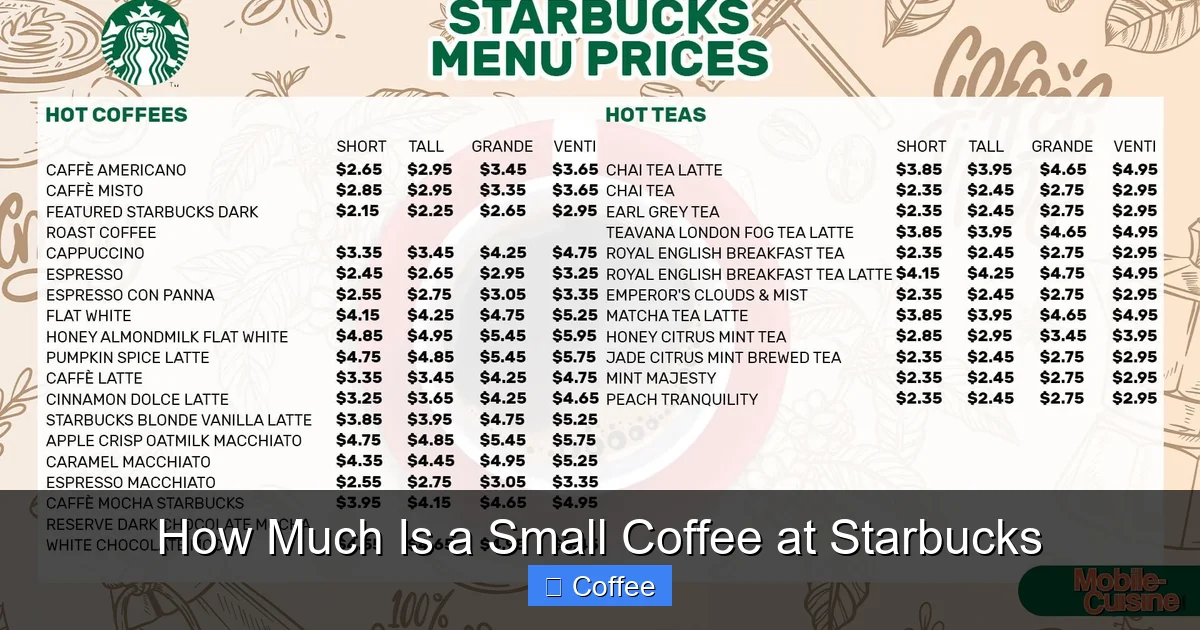
This is where most confusion begins. Walk into any Starbucks, and you’ll see sizes listed as Short, Tall, Grande, and Venti. Here’s the crucial detail many miss: **The Short is the actual small size.** It’s 8 fluid ounces. The Tall is 12 ounces – that’s the size most people *think* of as “small” when they walk in, but it’s Starbucks’ *medium* size. Ordering a “small coffee” and getting a Tall is a common, and costly, mistake.
*
The Short (8oz): The True Small
This is the smallest hot cup Starbucks offers for brewed coffee. It’s perfect if you want just a quick caffeine boost without the volume. **This is the size most people are asking about when they say “small coffee.”** As of late 2023/early 2024, the national average price for a Short hot brewed coffee (like Pike Place Roast, House Blend, or Veranda Blend) typically falls between **$2.00 and $2.75**. However, this is just the starting point. In high-cost cities like New York, San Francisco, or Boston, that same Short can easily be **$2.75 to $3.25 or even higher.** In more affordable areas or suburbs, you might find it closer to **$1.75 to $2.25.** Always check the menu board near the register for the most accurate local pricing.
*
The Tall (12oz): The Misunderstood “Small”
If you say “small coffee” and the barista grabs a Tall cup, you’ve likely ordered the next size up. A Tall hot brewed coffee averages **$2.50 to $3.50** nationally, with the same significant geographic variation as the Short. In expensive cities, it can hit **$3.50-$4.00.** While it holds more coffee, it also costs noticeably more than the Short. Understanding this size labeling is the first step to controlling your cost. If you truly want the smallest, cheapest option, you *must* ask for a “Short.”
*
Why the Size Names Are So Confusing
Starbucks introduced the “Short” size relatively recently (around 2018-2019) specifically to offer a smaller, cheaper option. Before that, the Tall *was* the smallest size available. This history, combined with the fact that “Tall” sounds small to most people, creates persistent confusion. Don’t feel bad if you’ve made this mistake – even regulars sometimes slip up! The key takeaway: **If price is your primary concern for a small coffee, explicitly ask for a “Short.”** It’s the only way to guarantee you’re getting the smallest, least expensive brewed coffee option.
Breaking Down the Price: What Makes a Small Coffee Cost What It Does?
Visual guide about How Much Is a Small Coffee at Starbucks
Image source: coffeebrewcafe.com
That $2.00-$3.50 price tag for a Short or Tall isn’t arbitrary. Several factors contribute to the final number you see on the screen. Understanding these helps explain why it’s often more than your local diner or gas station.
*
The Coffee Itself: Bean Quality & Sourcing
Starbucks invests heavily in its coffee sourcing. They have their own ethical sourcing standards (Coffee and Farmer Equity – C.A.F.E. Practices), which aim for quality and farmer support. While not all beans are single-origin or ultra-premium (like their Reserve line), even their standard Pike Place Roast involves a consistent, medium-roast blend sourced from Latin America and Asia. This focus on consistent quality and ethical sourcing contributes to the base cost compared to cheaper, mass-market commercial blends. You’re paying for the assurance of a familiar taste profile every single time.
*
Operational Costs: The Real Estate & Labor Factor
This is arguably the *biggest* driver of geographic price variation. Starbucks stores in prime urban locations (think Manhattan storefronts or downtown Chicago) pay astronomical rent. Staffing costs, including wages, benefits, and training, are also significantly higher in major metropolitan areas with higher minimum wages and cost of living. These operational expenses are baked into the price of every item, including that small coffee. A store in a small Midwest town has vastly lower overhead, allowing for lower prices. It’s not just about the coffee; it’s about the cost of running the shop where you buy it.
*
The Starbucks Experience: More Than Just Coffee
When you pay for a Starbucks coffee, you’re also paying for the environment. It’s the clean, consistent, Wi-Fi-enabled space. It’s the predictable experience – you know exactly what you’re getting, whether you’re in Seattle or Miami. It’s the convenience of ubiquitous locations, mobile ordering, and a streamlined (if sometimes complex) ordering process. For many customers, this “third place” experience – a comfortable spot between home and work – has tangible value that justifies a premium over a basic cup of joe. You’re not just buying caffeine; you’re buying a moment, a ritual, and a sense of belonging.
*
Menu Complexity & Customization Culture
Starbucks pioneered the highly customized coffee experience. While this is great for personalization, it adds complexity and cost. Training baristas to handle intricate drink modifications takes time and resources. The infrastructure for endless syrups, milks, and toppings requires space and inventory management. Even if you order a simple black coffee, the ecosystem built to support the Frappuccino-loving crowd influences the overall pricing structure. The base coffee price helps subsidize this complex menu.
How Much Does Location REALLY Impact the Price?
Visual guide about How Much Is a Small Coffee at Starbucks
Image source: cdn.shopify.com
We’ve mentioned it, but it’s so significant it deserves its own deep dive. The difference in price for the *exact same* Short brewed coffee between two Starbucks locations can be staggering. It’s not just “a little more” – it can be a full dollar or more.
*
City Tier Pricing: The Starbucks Map
Starbucks operates on a sophisticated pricing model that segments markets into tiers based on cost of living, real estate costs, and local competition. Think of it like airline pricing, but for coffee.
* **Tier 1 (Highest Cost):** Major global cities and expensive coastal metros. Examples: New York City (especially Manhattan), San Francisco, Boston, Washington D.C., Seattle (downtown/core). Here, a Short brewed coffee often starts at **$2.75-$3.25**, with Tall hot coffee frequently **$3.25-$3.75+.** Seasonal drinks or customizations push it even higher.
* **Tier 2 (Moderate Cost):** Large cities and affluent suburbs. Examples: Chicago, Los Angeles (outside prime areas), Austin, Denver, Portland, major university towns. Short coffee typically ranges **$2.25-$2.75**, Tall **$2.75-$3.25.**
* **Tier 3 (Lower Cost):** Smaller cities, suburbs, and rural areas. Examples: Much of the Midwest, South, and smaller regional cities. Short coffee can be as low as **$1.75-$2.25**, Tall **$2.25-$2.75.**
*h3>Real-World Examples: Short Coffee Prices Compared
Let’s put numbers to it (based on widespread reports and menu checks in late 2023/early 2024):
* **Manhattan, NYC:** Short Hot Brewed Coffee: **$3.25** | Tall Hot Brewed Coffee: **$3.75**
* **Downtown San Francisco:** Short Hot Brewed Coffee: **$3.15** | Tall Hot Brewed Coffee: **$3.65**
* **Austin, TX (Downtown):** Short Hot Brewed Coffee: **$2.65** | Tall Hot Brewed Coffee: **$3.15**
* **Suburban Chicago:** Short Hot Brewed Coffee: **$2.45** | Tall Hot Brewed Coffee: **$2.95**
* **Des Moines, IA:** Short Hot Brewed Coffee: **$2.10** | Tall Hot Brewed Coffee: **$2.60**
* **Small Town, Midwest:** Short Hot Brewed Coffee: **$1.85** | Tall Hot Brewed Coffee: **$2.35**
These examples highlight how location alone can add **$1.00-$1.40** to the cost of the same Short coffee compared to a lower-cost area. Always glance at the menu board – it’s the most reliable local indicator.
*
Why Doesn’t Starbucks Standardize Prices?
While it might seem frustrating, localized pricing makes business sense. Charging Manhattan prices in a small Iowa town would likely drive customers away to cheaper alternatives. Conversely, charging Iowa prices in Manhattan wouldn’t cover the exorbitant rent and labor costs. Starbucks aims to maximize revenue in each specific market based on what customers there are willing and able to pay, while still covering local operational expenses. It’s a balancing act driven by economics, not arbitrary decisions.
Beyond Black: How Customizations & Drink Types Change the Price
Ordering a simple black Short brewed coffee is the most budget-friendly option. But let’s be honest – many of us like a little something extra. Here’s how common modifications impact that “small coffee” price:
*
The Milk & Cream Factor
Adding dairy is the most common customization and significantly increases cost.
* **Splash of Milk/Cream:** Adding a small amount of 2% milk, whole milk, or non-dairy creamer (like Starbucks’ own) typically adds **$0.25-$0.50** to your Short coffee. This is often the most cost-effective way to soften the coffee.
* **Steamed Milk (e.g., for a “Café au Lait” style):** Turning your Short coffee into something resembling a small latte by adding steamed milk will cost **$0.75-$1.25 more.** The price reflects the extra milk volume and the barista’s time to steam it.
* **Non-Dairy Milks (Oat, Almond, Soy, Coconut):** These are almost always a premium add-on. Expect to pay an **additional $0.75-$1.00** for oat or almond milk in your Short coffee. Soy is usually slightly less, around **$0.50-$0.75.** This is a major price jump for a small coffee.
*
Sweeteners & Syrups: The Flavor Tax
Adding sugar is usually free (packets at the condiment bar), but flavored syrups come at a cost.
* **Standard Syrups (Vanilla, Caramel, Hazelnut, etc.):** Adding one pump of syrup to your Short coffee typically costs **$0.50-$0.75.** Two pumps? Double that. While it seems small, it adds up fast, especially if you get multiple pumps regularly.
* **Sugar-Free Syrups:** Usually the same price as regular syrups, **$0.50-$0.75 per pump.**
* **Specialty Syrups (e.g., White Chocolate Mocha, Seasonal):** Can sometimes cost a bit more, **$0.75-$1.00 per pump.**
*h3>Hot vs. Iced: The Temperature Premium
Ordering your small coffee iced isn’t free. Iced coffee requires more coffee grounds (to account for dilution from melting ice) and takes slightly more time to prepare. Expect to pay **$0.25-$0.50 more** for an iced Short coffee compared to the hot version. If you also add milk or syrup to the iced version, those costs stack on top.
*
Beyond Brewed: Espresso-Based “Small” Drinks
If you’re thinking of a small latte, cappuccino, or macchiato, the price structure changes entirely. These are espresso-based drinks, not brewed coffee.
* **Short Cappuccino/Latte:** A Short (8oz) cappuccino or latte (which contains 1 shot of espresso plus milk) typically starts around **$3.00-$4.00** nationally, heavily influenced by location and milk choice. This is significantly more than a Short brewed coffee.
* **Solo Shot of Espresso:** The absolute cheapest espresso option is a single shot (“Solo”) in a tiny cup, usually **$1.75-$2.50.** While not a “coffee” in the traditional sense, it’s the smallest, strongest caffeine hit Starbucks offers at a relatively low price point.
Remember: If you want milk and espresso in a small size, you’re paying for the espresso machine operation and milk, not just the brewed coffee base. The “small” size for these drinks is the Short cup, but the drink composition makes it pricier than black brewed coffee.
Smart Strategies: How to Save on Your Small Starbucks Coffee
Okay, so you know the baseline price and why it varies. Now, how do you actually spend less on that daily Short? It’s not about deprivation; it’s about smart habits and leveraging what Starbucks offers.
*
Master the Starbucks Rewards Program (It’s Essential!)
This is the single most effective way to reduce your effective cost per coffee. Here’s how it works for the small-coffee drinker:
* **Earn Stars:** You get 2 Stars for every $1 spent when you pay with the Starbucks app (or linked payment). A $2.50 Short coffee = 5 Stars.
* **Free Drink Threshold:** Once you hit 125 Stars (Gold Level), you get a free drink or food item of your choice. *Crucially, this includes any size, including the Short.* So, 5 Short coffees ($12.50 spent) = 25 Stars. You’d need about 5 more Shorts ($12.50) to reach 125 Stars and get your 10th Short coffee FREE. Your effective cost per coffee drops significantly over time.
* **Birthday Reward:** Gold members get a free drink or food item on their birthday.
* **Personalized Offers:** The app frequently sends targeted offers, like “Get 50 Bonus Stars on your next brewed coffee purchase” or “Free pastry with a drink purchase.” These are gold for the budget-conscious.
* **Mobile Order & Pay:** Order ahead in the app, skip the line, and earn Stars seamlessly. Often, the app highlights current offers.
**Pro Tip:** Always pay with the app linked to your Rewards account. Using cash or a non-linked card means you earn ZERO Stars – a huge missed opportunity for savings on frequent purchases.
*
Strategic Ordering: Size & Customization Hacks
* **Ask for “Short, Please”:** Be explicit. Don’t say “small”; say “Short.” It takes a second and saves you $0.50-$1.00 every time compared to a Tall.
* **Skip the Milk/Syrup (or Minimize):** If you can enjoy it black, you save $0.25-$1.50 per drink. If you need a little, ask for “just a splash” of milk – sometimes baristas will do it for free or a minimal charge, especially if you’re a regular.
* **Hot > Iced (Usually):** Unless you specifically want it cold, hot brewed coffee is generally cheaper than the iced version due to the dilution factor.
* **Refills for Rewards Members:** Gold members get a free *refill* of hot or iced brewed coffee (or tea) during the same visit. If you get a Short and want more later that day, ask for a refill instead of a whole new cup. (Note: This is for the *same* visit, not a return later).
*
Timing & Promotions: Catch the Deals
* **Happy Hour:** Starbucks occasionally runs “Happy Hour” promotions, usually on Thursday afternoons (e.g., 3 PM – 5 PM), offering 50% off select beverages, including brewed coffee. Sign up for emails or check the app for announcements.
* **Seasonal Promotions:** Around holidays (like Christmas or Pumpkin Spice season), they sometimes offer BOGO (Buy One, Get One) deals on specific drinks, or bonus Stars on purchases. While often targeted at specialty drinks, the bonus Stars still apply to your brewed coffee purchase.
* **”Free Coffee” Days:** Rarely, Starbucks might offer free coffee (usually a specific brewed coffee) on certain days (e.g., Election Day in some years). Follow their social media for surprises.
* **Bring Your Own Cup (BYOC):** While the discount is small ($0.10 off), it adds up over time and is eco-friendly. *Crucially, you still earn full Stars on the purchase price before the discount.* So a $2.50 coffee with BYOC costs $2.40, but you earn Stars on $2.50.
*
Consider the Alternatives (Within Starbucks)
* **Pike Place Roast vs. Featured Brew:** The standard Pike Place Roast is usually the cheapest brewed option. Featured brews (like Blonde Roast or Dark Roast) might cost the same or slightly more ($0.10-$0.25 extra). Stick with Pike Place for the lowest base price.
* **Water Station:** Feeling parched but not needing caffeine? The free water station (with lemon slices sometimes) is always an option to complement your coffee habit without added cost.
The Value Question: Is That Small Coffee Worth It?
We’ve crunched the numbers, but the ultimate question is subjective: Is paying $2.50-$3.50 for a Short coffee worth it *to you*? The answer depends entirely on what you value.
*
Comparing the Cost: Starbucks vs. The Alternatives
Let’s put it in perspective:
* **Gas Station/Convenience Store:** $1.00 – $2.00 for a large cup (often lower quality, inconsistent).
* **Local Diner/Cafe:** $1.50 – $2.50 for a standard cup (quality varies wildly, ambiance differs).
* **Home Brewing:** $0.20 – $0.50 per cup (requires equipment, time, cleanup – highest value per ounce, but lacks convenience/experience).
* **Starbucks Short:** $2.00 – $3.50 (consistent quality, prime location, ambiance, Wi-Fi, Rewards program).
On pure coffee cost per ounce, Starbucks is rarely the cheapest. A Short ($2.50 for 8oz) is **$0.31/oz**, while a large gas station coffee ($1.50 for 16oz) is **$0.09/oz**. Home brewing can be **$0.03/oz** or less.
*
What Are You *Really* Paying For?
The premium you pay at Starbucks buys more than just the liquid:
* **Consistency & Reliability:** You know *exactly* what you’re getting, every single time, anywhere in the country (or world). No bad batches, no surprise bitterness.
* **Convenience & Ubiquity:** Need coffee *now*? There’s likely a Starbucks within a few blocks or minutes drive. Mobile ordering makes it even easier.
* **The “Third Place” Experience:** For many, it’s a comfortable, safe, Wi-Fi-enabled space to work, meet, or just sit. This intangible value is significant for remote workers, students, or anyone needing a break.
* **Brand Trust & Ethical Sourcing (Perceived):** Many customers are willing to pay a bit more knowing Starbucks has (at least stated) commitments to ethical sourcing and farmer support, even if the reality is complex.
* **Rewards Program Value:** As we saw, for frequent buyers, the effective cost plummets thanks to free drinks and offers. The $2.50 Short becomes much cheaper over time.
*
Making the Decision That’s Right For You
Ask yourself:
* Do I value the consistency and convenience enough to pay the premium?
* Am I a frequent enough buyer to make the Rewards program worthwhile? (If you go 3+ times a week, absolutely yes).
* Can I enjoy it black, or do customizations push the price beyond my comfort zone?
* Do I actually use the space (Wi-Fi, seating) or am I just grabbing and going?
If you primarily want cheap caffeine and don’t care about the experience, brewing at home or hitting a gas station makes more sense. But if the ritual, the reliability, the space, or the Rewards perks matter to you, then that $2.50 Short coffee delivers significant value beyond the bean. It’s not *just* coffee; it’s a small part of your daily routine and environment. Understanding “how much is a small coffee at Starbucks” empowers you to decide if that value proposition aligns with your priorities and budget.
Conclusion: Knowledge is Your Best Brew
So, how much is a small coffee at Starbucks? As we’ve discovered, there’s no single magic number. The true cost of your Short (8oz) brewed coffee sits in a range, typically **$2.00 to $3.50**, heavily shaped by where you are, what you order, and how you order it. Location is the heavyweight champion of price variation – that Short in Manhattan costs nearly double what it does in a small Midwest town. Remember the size semantics: “Short” is small, “Tall” is medium. Customizations like milk, syrup, or going iced add up quickly, turning a $2.25 coffee into a $3.50+ drink before you know it.
But here’s the empowering part: **you have more control over the final price than you might think.** Mastering the Starbucks Rewards program is the ultimate game-changer, transforming that daily purchase into a path toward free drinks. Being explicit about ordering a “Short,” skipping unnecessary add-ons, and timing your visits for promotions can shave dollars off your monthly coffee spend. Understanding the “why” behind the price – the real estate, the labor, the consistent experience – helps you evaluate if it’s worth it *for you*.
Ultimately, that small cup is more than just caffeine. It’s a ritual, a moment of pause, a reliable anchor in a busy day. Whether you’re savoring it black at your desk, adding a splash of oat milk in a cozy corner, or grabbing it iced on the go, knowing the ins and outs of the price empowers you to enjoy your Starbucks moment consciously and cost-effectively. So next time you step up to the counter, you won’t just be asking “how much is a small coffee at Starbucks?” – you’ll know exactly what to expect and how to get the best value for your brew. Now, go enjoy that coffee, wisely!
Frequently Asked Questions
How much is a small coffee at Starbucks right now?
A standard Short (8oz) hot brewed coffee (like Pike Place Roast) typically costs between $2.00 and $3.50 in the US. The exact price depends heavily on your location, with major cities like New York or San Francisco often charging $2.75-$3.25+, while smaller towns may have prices closer to $1.75-$2.25. Always check the local menu board.
Why is Starbucks coffee so expensive compared to other places?
Starbucks prices reflect higher operational costs (prime real estate, labor in expensive areas), consistent quality control, ethical sourcing initiatives, and the value of the “third place” experience (clean, Wi-Fi-enabled space). You’re paying for reliability, convenience, and ambiance, not just the coffee beans themselves.
What size is considered “small” at Starbucks?
Starbucks’ actual small size is the **Short**, which holds 8 fluid ounces. Many customers mistakenly think the Tall (12oz) is small, but it’s their medium size. To get the cheapest brewed coffee option, you must specifically ask for a “Short.”
Does adding milk or sugar increase the price of a small coffee?
Yes, significantly. Adding a splash of milk or creamer usually costs $0.25-$0.50 extra. Steamed milk (for a latte-style drink) adds $0.75-$1.25. Non-dairy milks (oat, almond) cost an additional $0.75-$1.00. Flavored syrups add $0.50-$0.75 per pump. Sugar packets are free.
How can I save money on Starbucks coffee?
The most effective way is joining the Starbucks Rewards program (free via app). Earn Stars on every purchase, redeem 125 Stars for a free drink (any size), and get birthday rewards and personalized offers. Also, order a Short instead of Tall, skip unnecessary customizations, use mobile ordering, and take advantage of Happy Hour promotions when available.
Is Starbucks coffee worth the price?
It depends on your priorities. If you value absolute lowest cost per ounce, home brewing is cheaper. However, if you value consistent quality, convenience, ubiquitous locations, a comfortable space to work/meet, and the savings potential of the Rewards program (especially for frequent buyers), then the price is often justified by the overall experience and value beyond just the coffee.